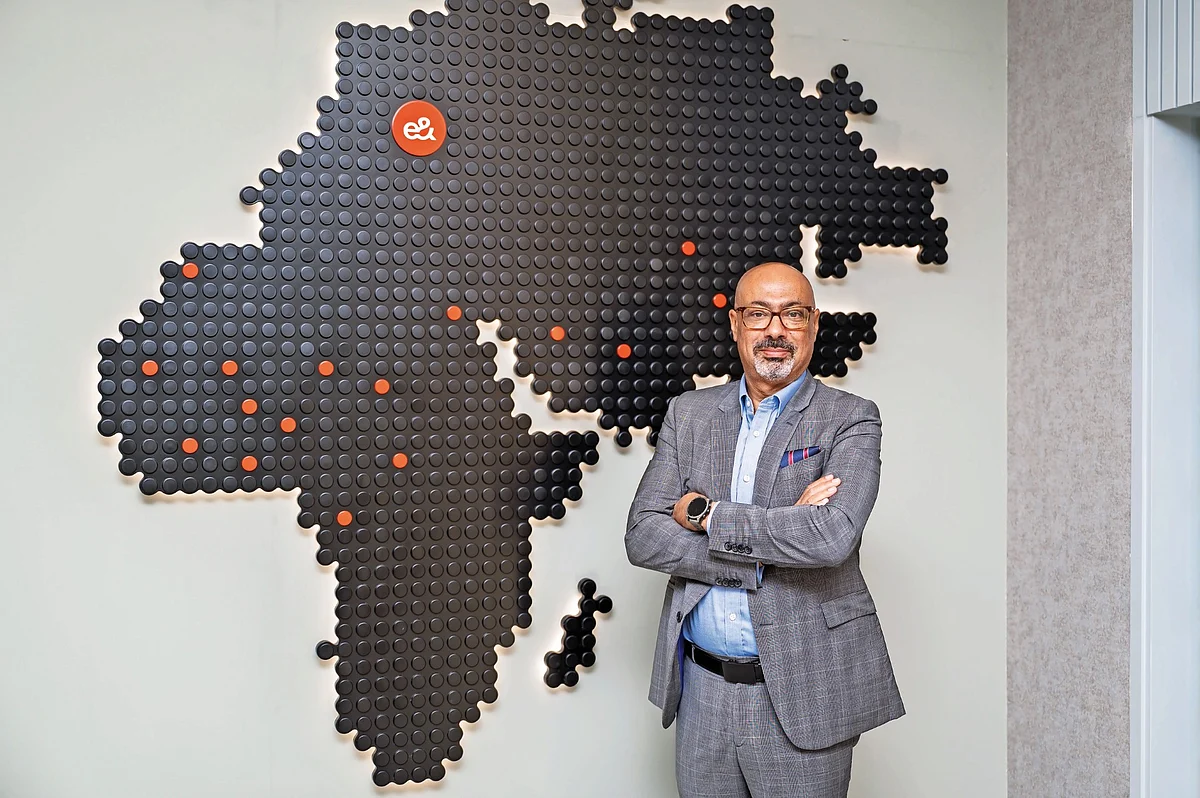
Hatem Dowidar, CEO of e&, sees the Middle East transforming into a global tech leader.
With strategic leadership, investments, and a booming innovation ecosystem, Dowidar believes the region has what it takes to secure its place on the world stage.
In an exclusive BTR interview, he discusses the importance of collaboration, digital transformation opportunities, and unlocking tech potential both regionally and globally.
Highlights from the interview:
What factors are enabling the Middle East to shift from being a consumer to an exporter of global tech platforms?
When I moved to the UAE a decade ago, the region was known for oil, the tallest building, and airlines. Now, we’re telling a new story where the Middle East is emerging as a leader in innovation and digital economies. The conditions are ripe for a transformation that extends beyond domestic impact, allowing us to create meaningful innovations.
Our design for scale and diversity from day one—spanning over 500 million people across various cultures and languages—makes the Middle East a natural testing ground for products adaptable to different price points, regulations, and user behaviors, which is crucial for global export.
Reflecting on the past few years, resilience stems from foresight. Covid-19 tested everything—economies, infrastructure, people—and yet, we adapted swiftly. Connectivity became the lifeline, enabling remote work, virtual education, digital healthcare, and e-commerce almost overnight. Telecom networks, backed by years of investment, provided the platform for rapid adaptation.
This wasn’t by chance. It was years of investment in reliable networks, digital infrastructure, and the resilience of our people. Fast, reliable connectivity is foundational to any digital economy, and we have it in abundance. Our region boasts world-class digital infrastructure with high-speed fiber, 5G networks, and cutting-edge data centers, equipping us to turn ideas into widespread innovation.
Beyond infrastructure, what sets the Middle East apart is the ambition of our leaders actively shaping national priorities.
We also have a young, dynamic population eager to learn and adapt. AI is already part of school curriculums here; these are seeds for long-term growth.
Our economic frameworks support this ambition. Investor-friendly policies, free zones, and visa regulations make it easy to scale startups and big ideas quickly. With air connectivity linking hubs like Dubai, Abu Dhabi, and Riyadh globally, exporting not just ideas but influence and solutions is easier than ever.
How is e& helping lead the shift from importing to building and scaling innovation globally?
Startups thrive on speed and risk. They move fast because they must. Big corporations often get bogged down by their size, hindering adaptability. At e&, we turned size into an advantage by creating verticals that operate with a startup mindset—fast, agile, and bold enough to take calculated risks. We don’t just partner with innovators; we build and invest in new tech companies.
e& money began as an early-stage fintech and is now scaling, bringing innovations like digitizing wage disbursement for domestic workers in the UAE in partnership with MoHRE and CBUAE.
Through e& capital, we invest in and support founders and platforms, helping them scale with our distribution, network, payments, and compliance capabilities.
e& capital has empowered disruptors like Fuze, a cornerstone of the Middle East’s digital asset ecosystem after processing over $2 billion in digital assets.
Or Nawy in Egypt, which closed one of Africa’s largest-ever proptech rounds to scale its mortgage services; and AppliedAI in Abu Dhabi, developing enterprise-grade AI models for regulated industries like finance, healthcare, and government. Investments like these show how we’re betting on innovation that can scale beyond its home market.
What are the key ingredients for creating a globally competitive tech platform in the region?
Global tech champions balance global thinking with strong local connections. In this region, governments are setting favorable conditions with widespread digital adoption, supportive regulation, and significant infrastructure investments. This provides a large enough home ground to test, refine, and prove solutions before global export.
However, building a global competitor alone is challenging. The best results occur when startups, corporates, governments, and investors collaborate, opening new opportunities and creating faster market routes.
Practically, this looks like teaming up with AWS and the UAE’s Cyber Security Council to launch the UAE Sovereign Launchpad, keeping sensitive data onshore while fast-tracking AI adoption to strengthen the UAE’s digital infrastructure. We’re also working with the UAE Cybersecurity Technology Innovation Bureau to create homegrown solutions. These initiatives are part of our AWS alliance, projected to contribute $181 billion to the UAE’s digital economy by 2033.
Talent and culture are crucial. You can have the best technology, but without the right people, innovation won’t thrive. It’s about upskilling our people and ensuring homegrown talent sees a future in building world-class tech companies here. We invest in our people through Emiratisation initiatives, the AI Graduate Programme, and the AI Academy. Our markets are young, bold, and digitally native. Succeeding here—navigating language and cultural diversity—proves you can compete globally.
Purpose drives everything we do. Our region has unique challenges and opportunities, and the technology we build must address real needs, whether in citizen services, sustainability, inclusion, or economic diversification. Anchoring innovation in purpose allows it to resonate globally.
Careem was a milestone. What lessons can be drawn from such success stories, and how is e& applying them?
Acquisitions drive growth, but the real work begins after the transaction. Since our investment in Careem, per-user GTV has increased by 74% year-on-year. In early 2025, Careem+ members accounted for over 55% of total GTV, indicating increased usage.
Smiles evolved from a simple loyalty program into a feature-rich app with over 5.5 million registered users. We’ve opened it to partners via Tencent Cloud’s ‘mini apps,’ making it easier for brands to integrate and for customers to access more services and rewards. We’re also enhancing value with offers like Amazon Prime redemptions directly in Smiles, deepening engagement and cross-selling.
The key is ensuring acquisitions drive synergy, innovation, and efficiency. At e&, we’ve learned from these strategies, applying them across our ecosystem to unlock value, enhance user experiences, and scale opportunities exponentially.
How are innovation hubs, investor networks, and policy environments evolving to support platform building?
The ecosystem is maturing simultaneously. A decade ago, the Middle East lacked the density of innovation hubs, investor networks, and supportive policies seen now. Today, these elements are aligning, empowering entrepreneurs and corporates to build scalable platforms.
Innovation hubs have evolved beyond co-working spaces. They are now places where new technologies are tested with real partners and customers. Governments are creating enabling policy environments, such as sandbox regulations, national AI strategies, and digital economy roadmaps, fostering growth.
Investor networks are also becoming more collaborative. At e&, we’ve seen the value firsthand. e& capital recently joined the Middle East Venture Capital Association (MEVCA), working collaboratively within the ecosystem, staying close to operating companies, and focusing on creating lasting value. This consensus reflects that no single player can build the next global platform alone; it requires a community that shares knowledge, spreads risk, and accelerates growth.
How do ambition, relevance, and resilience shape e&’s vision for global platforms?
The question is whether the platforms we create break down barriers or reinforce them. If the digital world isn’t becoming more inclusive, innovation is futile.
Future platforms will be judged not only by sophistication but by inclusivity. That’s why we launched Wider Web, making the internet accessible for those with cognitive, visual, and learning differences, and GoLearning, democratizing online learning.
The same spirit is present in our AI Graduate Programme, where 62% of new hires are women. Ensuring those shaping tomorrow’s platforms reflect societal diversity is vital. Partnering with AWS to bring cloud and AI to SMBs follows the same philosophy: equipping smaller players with tools once exclusive to large enterprises.
Ambition means being most useful. Resilience is surviving market cycles and ensuring entire communities thrive in the digital economy, not just a privileged few. This lens guides our investments and innovations.
What are your strategic goals and vision for 2026?
2026 focuses on scaling platform opportunities, building on existing foundations, and maximizing potential impact.
e& money has evolved into a comprehensive fintech platform offering IBAN accounts and accessible financial tools. This is just the beginning. We’re pushing boundaries, introducing more savings, investment options, lending solutions, and tools to empower financial inclusion.
We’re also emphasizing infrastructure, the backbone supporting these platforms.
From 5G to AI, cloud, and beyond, we’re building systems for innovation. Whether it’s entertainment, fintech, AI tools, or cloud ecosystems, our role is to enable growth for countries, industries, and businesses, ensuring social and economic utility.
The core benchmark is driving meaningful, sustainable growth. Success measures whether platforms and technologies create opportunities, remove barriers, and deliver tangible value to communities, economies, and industries. That’s the 2026 vision: growth that’s sustainable, inclusive, and future-ready.
Hatem Dowidar – Visionary Leader
Hatem Dowidar, CEO of e&, discusses the Middle East’s growing ambition to become a global tech platform exporter.
In a BTR interview, Dowidar explores building a platform designed for global scaling. He highlights the mindset shift, where local founders, investors, and ecosystems aim to own, grow, and export innovation. Through examples like Careem and other success stories, Dowidar outlines ambition, relevance, and resilience as key transformation drivers. He explains how innovation hubs, investor networks, government policies, and talent pools align to create globally competitive platforms.