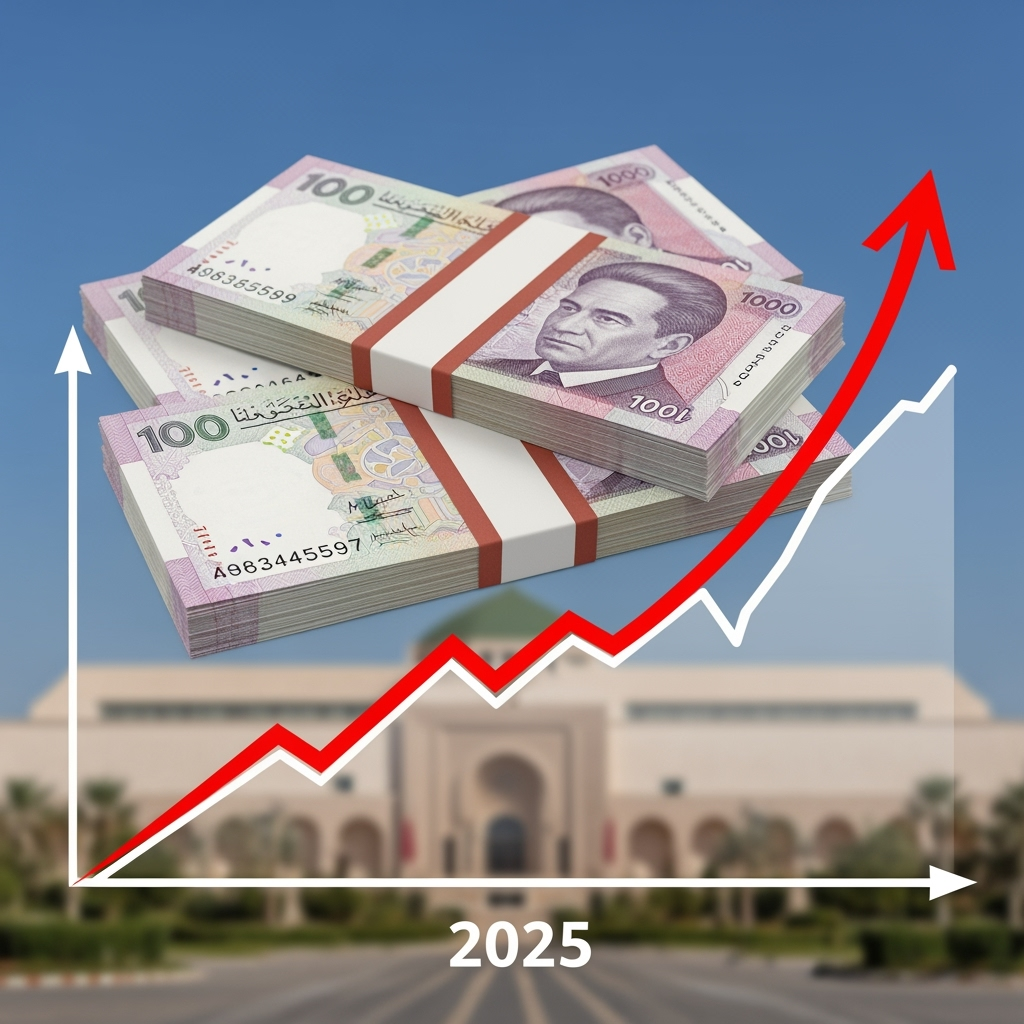
According to the ministry’s statement, the deficit reflects an increase in expenditures of 43.4 billion dirhams, surpassing the recorded increase in revenues estimated at 28.7 billion dirhams. Regarding the reasons for the deficit, Moroccan economist Dr. Abdelaziz Koukas said that there are many intertwined factors behind the rise in Morocco’s budget deficit, primarily the accelerating pace of public expenditures. Koukas added, in a statement to “Sputnik,” that public expenditures increased by 43.4 billion dirhams, exceeding the growth in revenues, which only rose by 28.7 billion dirhams, and this disparity directly contributed to the exacerbation of the deficit. He explained that among the reasons for the increase in expenditures are the rise in employee expenses by about 10.7 billion dirhams and an increase in service costs by 14 billion dirhams, which also reflects the growing debt burden on public finances. He also pointed out that the expansion of social protection programs and aid directed to vulnerable groups requires massive budgets, posing an additional burden.
Regarding the impacts of this deficit, Koukas indicated that there are short-term effects, such as the government resorting to increased borrowing to cover the deficit, which raises public debt levels, in addition to the pressure on financial liquidity that may lead to a negative impact on Morocco’s credit rating and an increase in future borrowing costs. In the long term, the economist warned that the continued deficit leads to the accumulation of public debt, increasing its service cost and reducing resources available for investment in vital sectors, and that reducing government investments and delaying projects may slow down the pace of economic growth.
Moroccan economist Ouhadi Said stated that according to the Ministry of Finance and Economy’s data, the budget deficit rose to 55 billion dirhams by the end of July 2025, compared to 40.2 billion dirhams during the same period in 2024. Said added, in a statement to ” “, that this situation is attributed to expenditures rising at a faster rate than revenues, with expenditures rising by approximately 43.3 billion dirhams, and an increase in goods and services costs by 24.7 billion dirhams, and an increase in debt interest by 4.9 billion dirhams, while compensation costs decreased by 4.5 billion dirhams. He explained that from the side of revenues, an increase of 28.7 billion dirhams was observed, driven particularly by a rise in tax revenues by 27.7 billion dirhams. Despite this rise in the deficit, the supervising ministry confirmed the emergence of an ordinary surplus amounting to 12.9 billion dirhams, indicating the maintenance of budgetary balances.
The economist pointed out that it is expected that Morocco will maintain its major balances in a positive context promising to achieve a growth rate of less than 4%, which will keep the budget deficit ratio relative to the gross national product under control. He noted that in the medium term, it is difficult to confirm what the situation will turn into, especially awaiting the United Nations decision next October on the issue of the Moroccan Sahara, which may open the door to massive investments in the southern regions, positively affecting the pressure on the state budget. However, he stressed that the fundamental question remains about the sustainability of rising tax revenues and their impact on the liquidity of companies and their resilience.
Ouhadi Said concluded his statement by saying that Morocco will maintain its major balances, awaiting the outcome of the upcoming elections and the formation of a future government that will have to move at full speed to implement the 2030 World Cup projects and achieve Morocco’s Vision 2030. Moroccan economist Amin Sami said that the data on the increase in Morocco’s budget deficit is generally correct, with the deficit reaching about 53.7 billion dirhams by the end of July 2025, compared to 40.2 billion dirhams in the same period of the previous year. Sami added, in a statement to ” “, that the deficit expanded because expenditures, including salaries, goods, services, interest, and investment, accelerated at a faster pace than resource growth, despite improved taxation and reduced compensation expenses.
He explained that according to the directive memorandum for the 2026 finance bill project, the government aims to reduce the deficit to about 3% of GDP while keeping debt at about 65.8%, which assumes tighter control of current expenditures, rationalization of investment, expansion of the tax base, and improved collection, confirming that the success of these measures will gradually restore balance to public finances. Sami believes that the next phase needs a qualitative leap in spending efficiency, activation of deep reforms, and linking the budget to results and regional productivity, which are the keys to transitioning from structural deficit to financial sustainability. He called for the budgetary control through reducing unnecessary operating expenses by 30% in public administrations, reforming taxes through digitalization of collection, integrating the informal sector, and supporting private investment to stimulate businesses to contribute to wealth creation, while continuing to rationalize and monitor the effectiveness of social protection programs.
Net revenues, after accounting for, achieved a completion rate of 57.4% compared to the finance law’s expectations, with an increase of 14.5% compared to the end of July 2024. Tax revenues contributed to this increase with a total of 201.8 billion dirhams, an increase of 27.7 billion dirhams, according to the Moroccan press. Ordinary expenditures rose to 213.9 billion dirhams, an increase of 25.1 billion dirhams, due to the rise in goods and services costs by 24.7 billion dirhams, and debt interest by 4.9 billion dirhams, while compensation costs saw a decline of 4.5 billion dirhams.