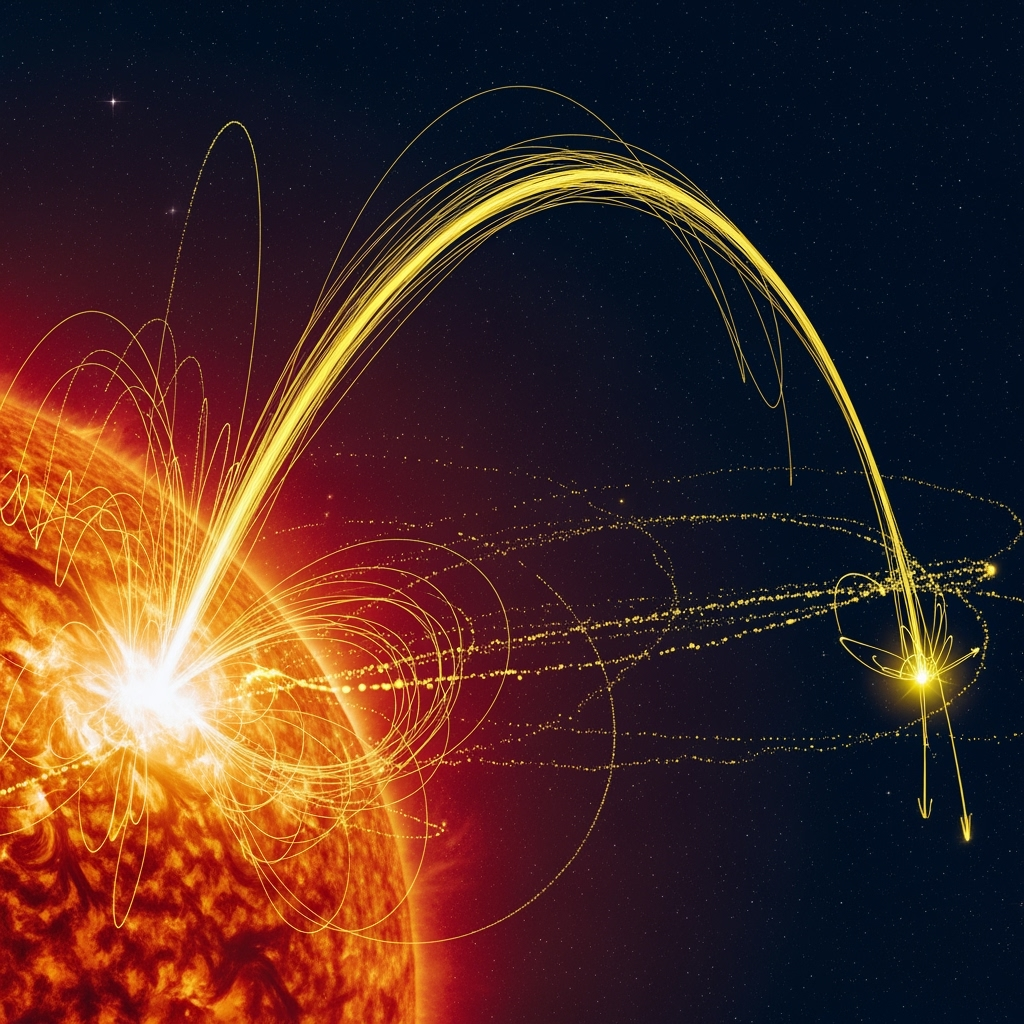
The study, published in “The Astrophysical Journal Letters” and reported by “Science News Today”, offers a new explanation to solve an astronomical mystery that has puzzled scientists since the 1970s regarding the broad spectral lines of these eruptions. The researchers explained that ions, which are positively charged particles in solar plasma, heat up significantly more than electrons during solar flares, due to a process known as “magnetic reconnection.” This discovery reshapes our understanding of energy transfer within solar plasma and highlights the complexity of these phenomena that produce immense energy exceeding 10 million degrees Celsius.
Solar flares pose a threat to spacecraft and astronauts due to increased X-rays and radiation reaching Earth, affecting the upper layers of the atmosphere, as well as communication and navigation systems, and even power grids. For decades, scientists have wondered why the spectral lines of solar flares, which are intense light emissions at specific wavelengths in ultraviolet and X-rays, appear broader than traditional models predict. The common explanation attributed this to random disturbances in the plasma, but this was unconvincing due to a lack of clear evidence.
This explanation reshapes our understanding of dynamics and offers a more accurate model for analyzing solar flares. The study was led by Dr. Alexander Russell from the School of Mathematics and Statistics at the University of St. Andrews, who confirmed that the team relied on data from other fields, such as near-Earth space and solar winds, to confirm that magnetic reconnection heats ions at a much higher rate than electrons.
He added, “This cosmic principle, confirmed by computer simulations, is now being applied for the first time to solar flares, solving a mystery that has lasted half a century.” This discovery opens new horizons for developing more accurate models of solar dynamics, enhancing the ability to predict space phenomena and protect technological infrastructure on Earth. The research also reshapes the scientific view of one of the most complex phenomena in our closest star, contributing to a deeper understanding of solar physics.