Social workers and caregivers dedicate their lives to supporting families, children, and vulnerable groups, often overlooking their own well-being. Social workers, in particular, confront abuse cases, family crises, and vulnerable communities daily. But who cares for them?
Dr. Asma Al Fahim, Executive Director of the Family Cases Sector at the Family Care Authority in Abu Dhabi, insists this needs to change. “Social workers and caregivers must prioritize their well-being to prevent burnout,” she emphasized at the Social Care Forum Second Edition (2025) on Wednesday, September 24.
“Everyone knows their limits and boundaries,” she continued. “Don’t wait to reach a breaking point. It’s okay not to feel well, to be emotionally affected by the cases you handle, and it’s absolutely fine to seek help.”
Stay updated with the latest news. Follow KT on WhatsApp Channels.
She highlighted the need for counseling, therapeutic sessions, and practice communities where social workers can recharge and build resilience. “Each individual should recognize what helps them recover and grow stronger. This is a humanitarian profession, not just a financial one, driven by deep care. That’s why I transitioned from finance to social work.”
The two-day forum, organized by the Department of Community Development (DCD) in collaboration with Deloitte, brought together policymakers, service providers, and international experts to explore how local, regional, and global strategies can redefine the future of social care.
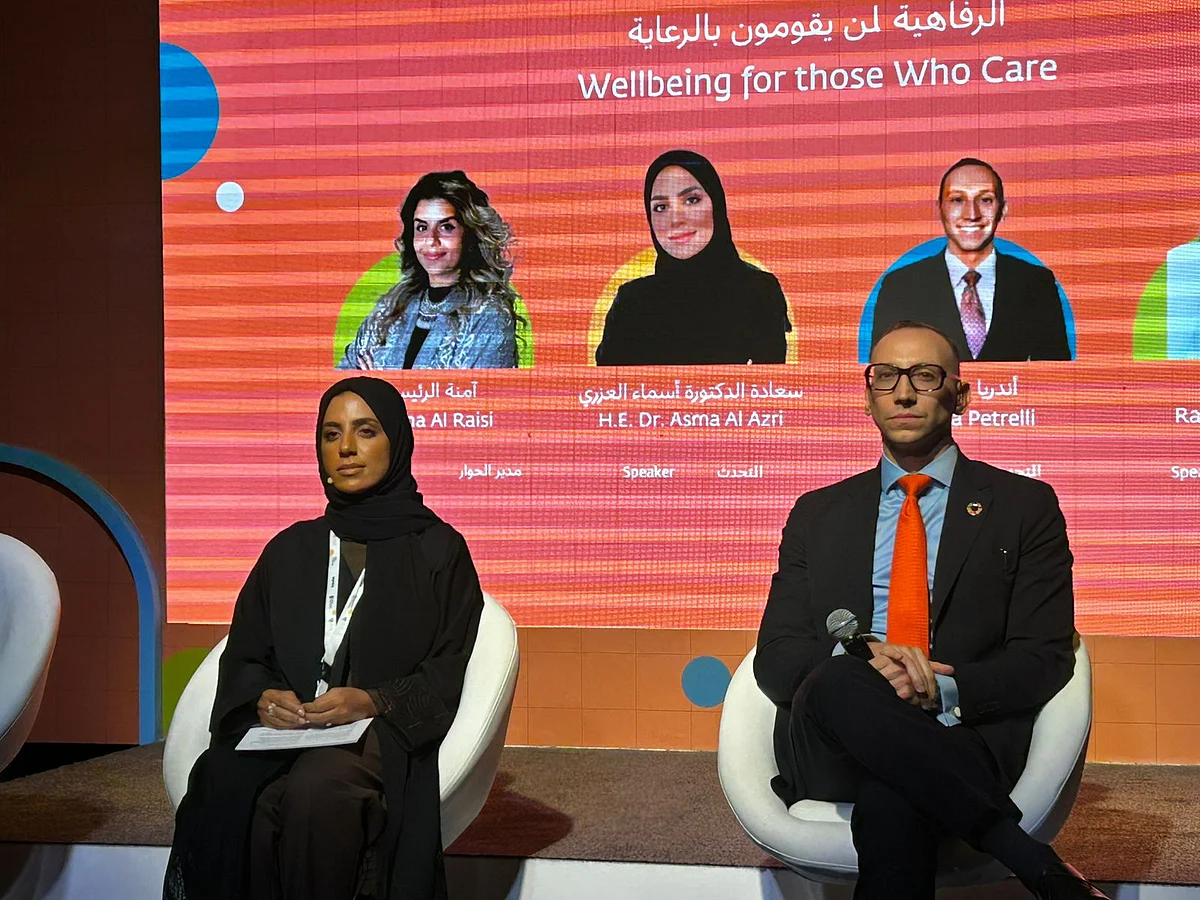
Dr. Asma Al Fahim and Andrea Petrelli. Photo: Waad Barakat
During the session, Raphaela Hyee, an economist at the OECD in France, pointed out the global shortage of social workers. “With analytics, the world will need 3 million more social workers in the future,” she noted.
When Khaleej Times queried Dr. Asma about the UAE’s situation, she explained, “It’s about functionality. If sectors like education, health, and social care have efficient social workers, the numbers needed decrease. We aim for sufficient social workers in every sector. If each functions well, overall demand drops, making social work a more appealing career for school graduates.”
Globally, the care sector faces substantial challenges. Andrea Petrelli, a social protection expert, shared that 2.1 billion people currently need care, including children under six, older persons, and individuals with disabilities, with the figure expected to rise to 2.3 billion by 2030. The care workforce comprises 381 million jobs worldwide, representing 11.5% of total employment, with health and education being the largest sectors.
However, caregiving extends beyond formal employment. Globally, 16.4 billion hours of unpaid care work are performed daily, equating to 2 billion full-time jobs. In Arab states, women perform 4.7 times more unpaid care work than men.
Petrelli stressed that care is not just a family responsibility but a public good. “Recognizing and investing in the care economy strengthens labor markets and societies. Care work, paid or unpaid, underpins our economies, supports families, and ensures community well-being,” she stated.
She also emphasized the need for policies supporting both formal and informal caregivers, including fair compensation, training, and mental health support, to ensure the sector’s sustainability as global demand grows.