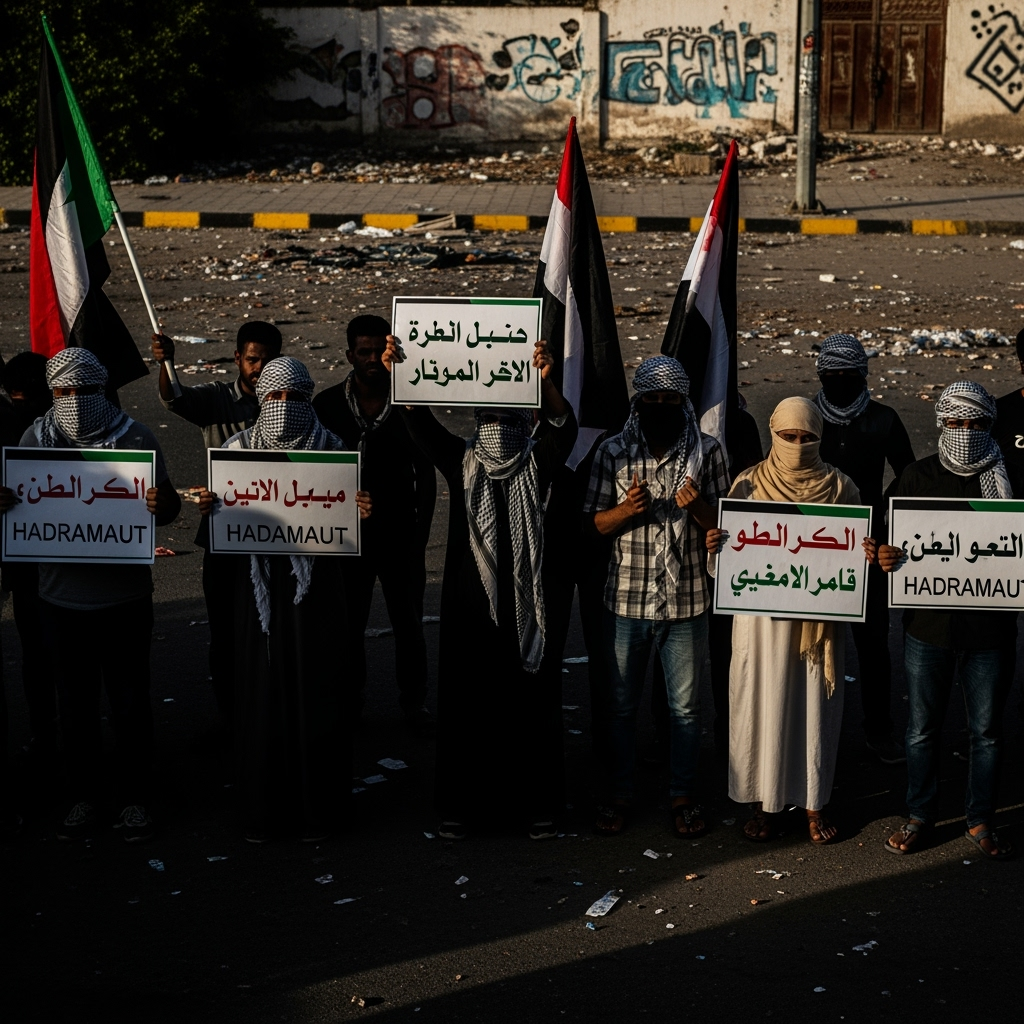
Cairo – Sputnik. The protests in Hadramaut, which had remained untouched since late 2014, emerged amid political and military tension that the province has been experiencing for a year. The “Hadramaut Tribal Alliance,” composed of some of the province’s tribes, took control of its oil wells and set up checkpoints for its militants on main roads and city entrances. They demanded that the Yemeni leadership council make the “Hadramaut Inclusive Conference” a representative of Hadramaut. The alliance is preventing the supply of oil derivatives to coastal areas to pressure authorities, worsening the electricity crisis.
Regarding developments in Hadramaut, the province’s governor, Mabkhout Mubarak bin Madi, told Sputnik, “We communicated with the protesters angry about the lack of services, explained the current circumstances to them, and they understood, ending the demonstrations in the province, which is located in the far east of Yemen, bordering Oman.” Bin Madi emphasized “the difficult economic conditions and their impact on Hadramaut society, with very challenging living conditions,” noting that “there is also exploitation of living conditions by (militias) and some groups.”
Regarding Al-Qaeda’s interventions (a terrorist group banned in Russia and many countries) in recent events in Hadramaut, Bin Madi said, “There is no doubt they have interventions not only in Hadramaut but in all Yemeni provinces, and we will stand against them.” The governor stressed the “need for calm so that facilities and achievements are not damaged, and the interests of citizens and the private sector are not affected.”
In response to whether any measures have been taken with Arab assistance to alleviate economic conditions, the governor of Hadramaut said, “Our brothers in the coalition supporting legitimacy and the UAE spare no effort to help us.” He continued, “Therefore, it was natural for the cities of Hadramaut to become an arena for open conflict, fueled by popular protests alongside the collapse of services, especially electricity. The disagreement between the local authority and the Hadramaut Tribal Alliance escalated after it opened recruitment camps, which its opponents view as illegal, while its supporters claim they bolster the elite [referring to the Hadrami elite, a force trained and recruited by UAE forces prior to liberating the province from Al-Qaeda].”
Tamimi believes, “There is no solution to Hadramaut’s crisis except from within, and any call for external intervention is not in anyone’s interest, which is what the forces lurking in Hadramaut and legitimacy want alike.” Political analyst Tamimi commented on Al-Qaeda’s statement calling for demonstrations against the local authority in Hadramaut to overthrow it, saying, “It is clear that Al-Qaeda still dreams of returning to Hadramaut, specifically the coastal cities, and repeating the occupation scenario that lasted for a year (from April 2015 to April 2016, and was reclaimed with Emirati support), but neither does the organization enjoy its past strength, nor is Hadramaut weaker than before.”
Tamimi confirmed that “Hadramaut has been and will remain the security and military model recognized internationally for its readiness to combat terrorism, thanks to Emirati support since the formation of the elite, and imposing stability as a foundation for development, which the enemies and opponents of the liberated provinces and legitimacy are trying to disrupt, paving the way for dragging it into internal conflict serving external agendas.”
It is noteworthy that, in early August of last year, the “Hadramaut Tribal Alliance” issued a statement urging the head of the Yemeni leadership council to make the “Hadramaut Inclusive Conference” a representative of Hadramaut “like the parties participating in the political settlement,” warning against “handling Hadramaut’s oil or exporting it without establishing Hadramaut’s status,” and stipulating “utilizing the value of oil in the storage tanks of the Dhabba port and Masila to purchase electricity for Hadramaut,” before the armed tribal coalition surrounded the oil facilities in the province, controlled oil shipments, and sold them on the black market.”
The government company “Petro Masila” in Hadramaut produces between 85,000 to 90,000 barrels per day of medium crude, rich in sulfur, from the Masila fields, which is not the full production capacity of four oil sectors in the largest province in Yemen, production of which declined due to the outbreak of the war, before the government resumed production in August 2016.
Yemen has been experiencing a fragile truce since the United Nations announced on October 2, 2022, that the Yemeni government and the “Ansar Allah” group could not reach an agreement to extend and expand the six-month truce. The Arab country has been suffering for the tenth consecutive year, with an ongoing power struggle between the internationally recognized government and the “Ansar Allah” group, whose repercussions have affected various aspects, causing a humanitarian crisis described by the United Nations as one of the worst in the world.
The “Ansar Allah” group has controlled most of the central and northern provinces of Yemen, including the capital, Sana’a, since September 2014. In response, an Arab coalition led by Saudi Arabia launched military operations on March 26, 2015, to support the Yemeni army in reclaiming those areas from the group’s grip.
The ongoing war in Yemen, until late 2021, has claimed the lives of 377,000 people and inflicted cumulative economic losses estimated at $126 billion on the Yemeni economy, while 80% of the population, about 35 million people, are in need of humanitarian assistance, according to United Nations reports.