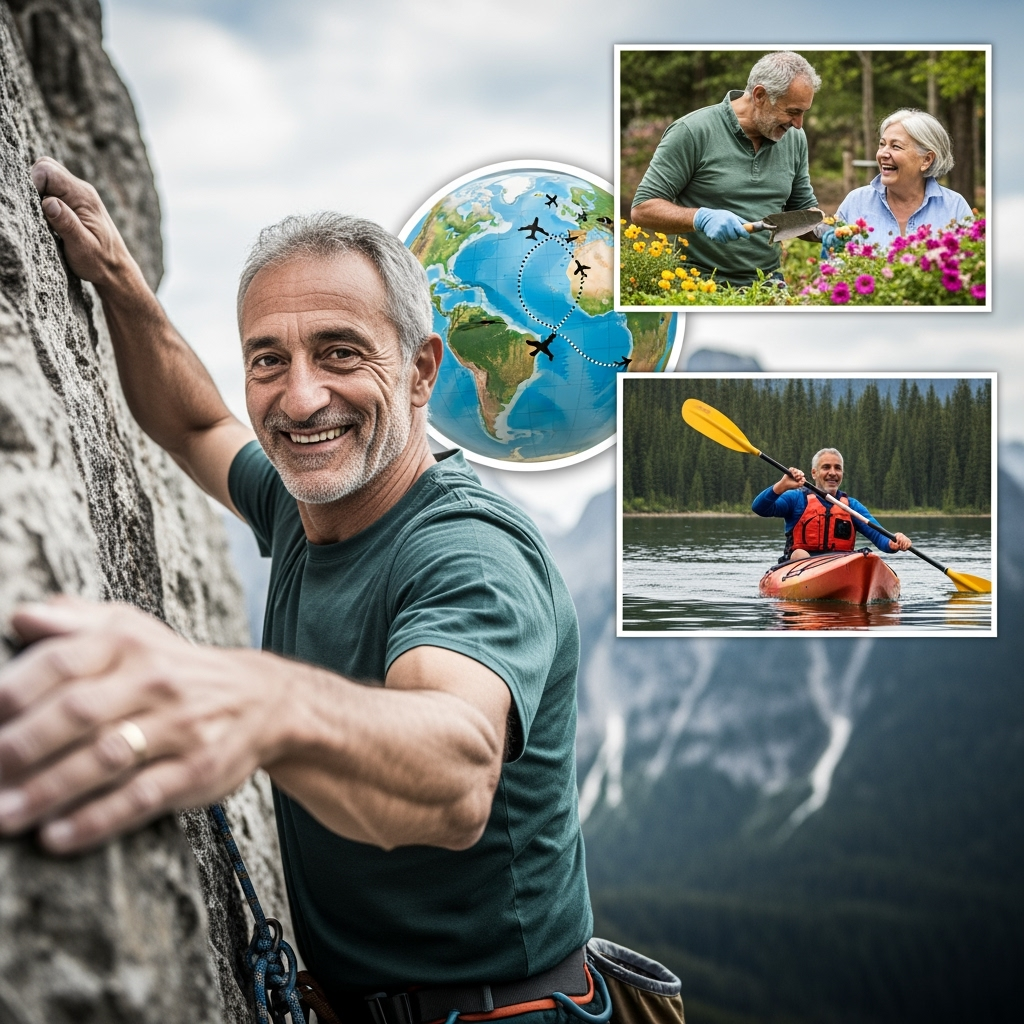
However, for Tunisian ‘Samir Ben Yacoub,’ it was not the end of the line or a warrior’s rest, but the beginning of a second life. On his bicycle, Samir Ben Yacoub (63 years old) travels the world’s cities after his retirement, seeking new adventures and escaping the clutches of routine. He turned his passion into a lifestyle, covering thousands of kilometers on his bike to promote eco-friendly travel among people. Between stops, he inspired dozens of Tunisians and others to follow his path. Since June 2006, when he closed the last page of his career as a department head at a hotel on the island of Djerba (southern Tunisia), he opened a new chapter of a different nature, a chapter written with bicycle pedals, carrying the spirit of adventure and an unquenchable desire for discovery. He did not seek the comfort of airplane seats or the silence of luxurious cars, but a continuous rhythm between his bicycle wheels and the road, as if he wanted to hear the sound of freedom in every turn. In his view, retirement is not a moment of extinguishment but the beginning of a new birth, a time that offers its owner an irreplaceable opportunity to live as he wishes, far from the clutches of routine work. With each pedal stroke, Samir proves that age is just a number and that as long as the heart remains open to knowledge, the road ahead remains endless. Thus, the sixty-year-old turned his years of emptiness into seasons of travel, dedicating two or three months a year before returning to his family in Tunisia, laden with stories of cities, faces of strangers, and the scents of roads. He recounts his adventures as if they were stories from travel diaries, bearing witness to a human experience that broke stereotypes and opened a door for himself to a world that renews with every journey. From his early years, Samir Ben Yacoub was drawn to nature, filled with the desire to explore and search for the details of things. It was as if the call of the earth and human curiosity were embracing within him to form his compass after retirement. He tells Sputnik: ‘I studied thoroughly how I could live this phase away from the routine of cafes and wasting time without benefit, and I looked for the means that align with my passion for nature and my love for sports, and I found that traveling by bicycle is the perfect choice.’ The decision was not random but the result of long thinking about the reasons that made him cling to the bicycle over anything else. He explained that it was not driven by economic reasons alone, although ‘traveling by bicycle costs almost nothing compared to fuel and maintenance expenses,’ but also for environmental reasons, as he believes in the necessity that the journey be eco-friendly and pollution-free. He added with a smile that the sports aspect was strongly present, as the bicycle ‘keeps the body in constant motion.’ Besides these motivations, Samir wanted to travel slowly, deliberately slow to allow him to contemplate the details of the road. He said, ‘I call it slow travel because I travel at a speed of 10 or 15 kilometers per hour, and this gives me the time to live the small details, greet people in the streets, have passing conversations with them, or capture a photo that immortalizes a fleeting scene.’ That slowness, which some might see as an obstacle, was for him a secret to making travel closer to people and richer in moments, as he could accept an invitation from a passerby or join a simple session without being bound by the schedule of a flight or the speed of a train. But Samir’s project was not just a personal journey to fill time; it was more than that. He sees that he carries a clear message: promoting the culture of cycling as an economical, healthy, and environmentally friendly means of transportation, and advocating for traveling by it as an alternative option that opens new horizons for humans. He confidently says: ‘Every year, the number of people who consider me a source of inspiration increases, and I feel that I have achieved my goal when I see someone following in my footsteps and traveling by bicycle, whether inside or outside Tunisia.’ His role did not stop at inspiration; many contact him who wish to undertake the experience, and he offers them advice and guidance on how to choose supplies, shares his accumulated travel experiences, and even teaches them how to take photos and videos and document the journey in writing. Thus, his experience turned into a small school for adventure lovers and a source of spreading a new culture that takes the path slowly but steadily. The beginning was simple, akin to an initial exercise in venturing into the unknown, Samir Ben Yacoub recounts to Sputnik: ‘My first trip was in my country, specifically on the island of Djerba, a few months after retirement. I bought a bicycle and began touring the island, which stretches over twenty kilometers… Djerba was my first discovery.’ But soon, the small experience turned into a bigger ambition, and he set off from Djerba towards the capital, Tunis, then to other provinces, before concluding his tour across the country from the center to the north and south, in a journey that lasted a month and a few days.’ That tour was not just travel but carried a deep humanitarian message, as he participated in an awareness campaign for autism on the occasion of the International Year of Autism, during which he visited twelve associations and institutions concerned with children, to say about that experience: ‘It was an opportunity where I learned a lot about what I was ignorant of about this disease, about its causes and treatment methods, and it affected me greatly on a human level.’ From Tunisia, his bicycle took him on his first trip abroad, to neighboring Algeria, because it did not require a visa or air travel. There, he toured northern Algeria to the Moroccan border in a journey that lasted a full month. With gratitude, Samir Ben Yacoub describes that experience: ‘I felt the warmth of the Algerian people’s hospitality, which encouraged me to think about other destinations.’ Thus, Morocco followed, then Jordan and Egypt, before travel halted temporarily during the Corona pandemic, only to resume afterward on his major journey to Turkey and Iran, where he spent two full months. He says that that trip was pivotal in his journey because it was the first time people began to follow his adventures on social media, where he documented his daily activities with photos, videos, and writing in a humorous style that captured the attention of followers of all ages and backgrounds. In another adventure, his passion led him to the ‘Sindh and India journey,’ which took him to Pakistan and India, which he confirms was a successful and rich journey. It was followed by a tour in Southeast Asia, where he visited six countries, including Indonesia, Malaysia, and Thailand, ‘a challenging journey due to the difficult terrain but enjoyable for the beauty of nature and the generosity and friendliness of the people.’ As for this year, he decided to open a new chapter in West Africa. He says: ‘I started from Nouakchott in Mauritania, then Senegal and Gambia, and I am now in Guinea-Bissau, with the journey set to continue to Conakry, Sierra Leone, Nigeria, Côte d’Ivoire, Ghana, Togo, and Burkina Faso.’ Samir does not leave his trips to chance, as planning begins theoretically by researching the experiences of those who preceded him by bicycle to those places, through ‘YouTube’ clips and other sources, to determine the nature of difficulties and living conditions. Afterward, he precisely plots his route and prepares his trip budget from his personal pension without any external support. He confirms that ‘every trip has its challenges,’ whether in very hot or torrentially rainy weather, or in rugged terrain, but he has learned how to deal with that as part of the journey. Samir carries a small self-sufficient world on his bicycle: a tent to sleep in, clothing and medicine, food, a solar panel to charge his phone and cameras, along with maintenance tools. Wherever he arrives, he can set up his tent or repair his bicycle with his own hands. Thus, the road becomes a mobile home, and the bicycle a loyal companion that accompanies him from the corners of Tunisia to the ends of the world. Among the dozens of countries Samir Ben Yacoub has traversed, Iran and India have remained etched in his memory as significant milestones. He tells Sputnik: ‘The country that impacted me greatly is Iran, due to the preconceived ideas and false perceptions people have about it. During my journey, I found a reality completely different from what is promoted. Iran is a very safe, open, and developed country.’ As for India, it left an indelible mark on him, thanks to its ethnic and cultural diversity. He describes it by saying: ‘No matter where you travel from one province to another, you will only find the peaceful and well-mannered Indian. I ate with them, slept in their temples, and prayed in their mosques, and that’s why its features remained in my memory just like Iran.’ For Samir, travel was not just moving from one country to another, but a complete school of life. It changed his perspective on existence and contentment with what is available, as he discovered that there are those who live below the poverty line and yet possess happiness and contentment far exceeding what others possess in affluent living. From there, he learned that a little is enough if the heart is filled with contentment. The road also brought him together with other travelers, some on bicycles, motorcycles, or cars. Their meetings, he says, were an opportunity to share common values: love for others, humility, simplicity, and a passion for discovery. Because Samir covers thousands of kilometers on his bicycle, he always amazes people in the countries he visits, ‘Many do not believe that I have covered five thousand kilometers by bicycle, and they only believe it when I show them the photos documenting the journey,’ he says with a confident smile. As for the future, he realizes that his ability to ride a bicycle may diminish with age, but he insists on remaining faithful to his passion: ‘My health allows me to continue this hobby for another five or ten years, and even if I am unable to ride a bicycle, I will continue traveling by car, the important thing is not to give up.’ He concludes his message by giving sincere advice to every retiree to find something that fills their time with meaning, not emptiness, and says: ‘I advise every retiree to think months before retirement about a way to fill their time, it could be community work, a volunteer activity, or practicing a sport or hobby they were deprived of during their working years… not spending time in cafes or playing cards.’