This path comes at a time when there are increasing calls to expand the scope of foreign relations beyond traditional partners and to seek new markets and promising investment opportunities. Several Tunisian diplomats believe that although this approach is important, it faces numerous challenges that can only be overcome by developing a comprehensive strategic plan covering various political, economic, and cultural fields.
Tunisian President Kais Saied received a phone call from his South African counterpart in the same month, reminding him of ‘the dream that the founding fathers had when the Organization of African Unity was established in 1963,’ among them the late leader Habib Bourguiba and Thomas Sankara.
Recently, the Carthage Palace witnessed a ceremony for the reception of credentials from several new ambassadors to Tunisia, including ambassadors from Gabon, South Africa, Ivory Coast, and India, symbolizing a wider diplomatic openness towards Africa and the world.
Former diplomat Abdullah Al-Abidi stated to ‘Sputnik’ that ‘Tunisian-African relations are not new but have roots going back to the 1960s when the late president visited several African countries and met with historic leaders, including the President of Ghana, paving the way for the establishment of the Organization of African Unity.’ Al-Abidi added that ‘Tunisia was one of the first countries to support Nelson Mandela in his struggle against the apartheid regime, granting him a Tunisian passport in 1963 that allowed him to move freely and advocate for his cause.’
He pointed out that ‘the next phase requires strengthening economic and cultural cooperation and attracting investments by activating previously signed agreements, especially those related to the African Continental Free Trade Area.’
Former Tunisian Foreign Minister Ahmed Wanis sees that ‘the Tunisian state is working to improve its international standing by expanding its diplomatic representation in Africa, Europe, and Asia, and developing its consular services.’ Wanis added in statements to ‘Sputnik’: ‘Tunisia’s relationship with its continent today needs renewal and development in light of geopolitical transformations that compel Tunisia to head south without delay.’
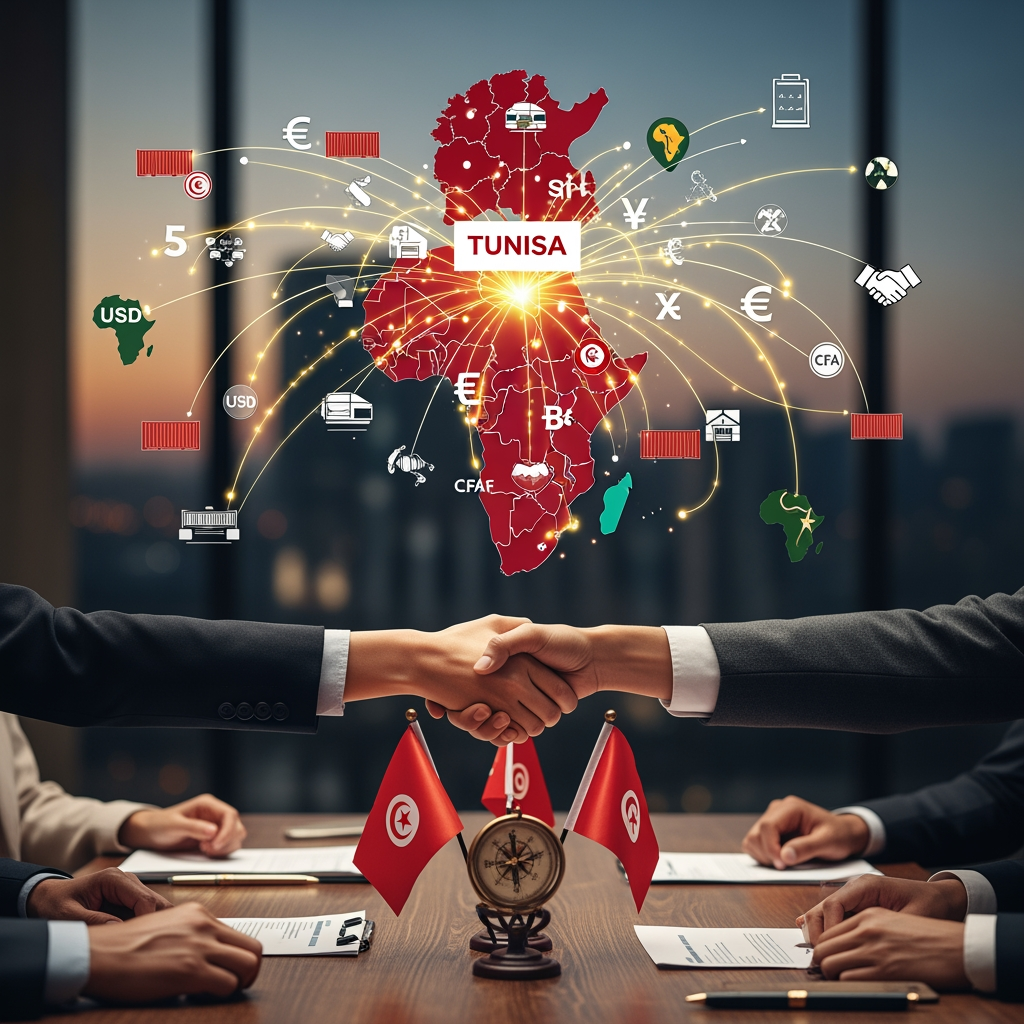
Tunisia is betting on the ‘Gateway to Africa’ project, a continental trade corridor aimed at making the country a major hub linking Europe to the African interior via Libya, expected to connect Tunisia to countries like Chad, Niger, and the Central African Republic.
In the same context, Minister of Trade and Export Development Samir Abid, during the opening of the Tunisian workshop accompanying the Intra-African Trade Fair in Algeria, confirmed that Tunisia has completed 350 trade operations within the framework of the African Continental Free Trade Area, reflecting its commitment to activating this continental economic initiative.
Political analyst Salah Eddin Al-Jurshi believes that ‘Tunisia’s economic and political future has become linked to its ability to build strong relationships with Africa,’ noting that ‘this approach is not without challenges.’ He added that strengthening proximity requires ‘a comprehensive and more integrated strategic approach, based on developing economic infrastructure, improving trade relations, and attracting African investments, which are the goals that the Tunisian government is working to achieve as part of a plan to diversify economic partners.’
It is worth mentioning that Tunisia has adopted a more open policy towards African markets in recent years, by joining the Common Market for Eastern and Southern Africa (COMESA) in 2018, one of the largest economic blocs comprising 19 countries. This agreement allows the liberalization of trade exchanges for agricultural and industrial products and services, enabling Tunisia to export its products in the fields of food industries, pharmaceuticals, building materials, mechanical and electrical industries, and others.