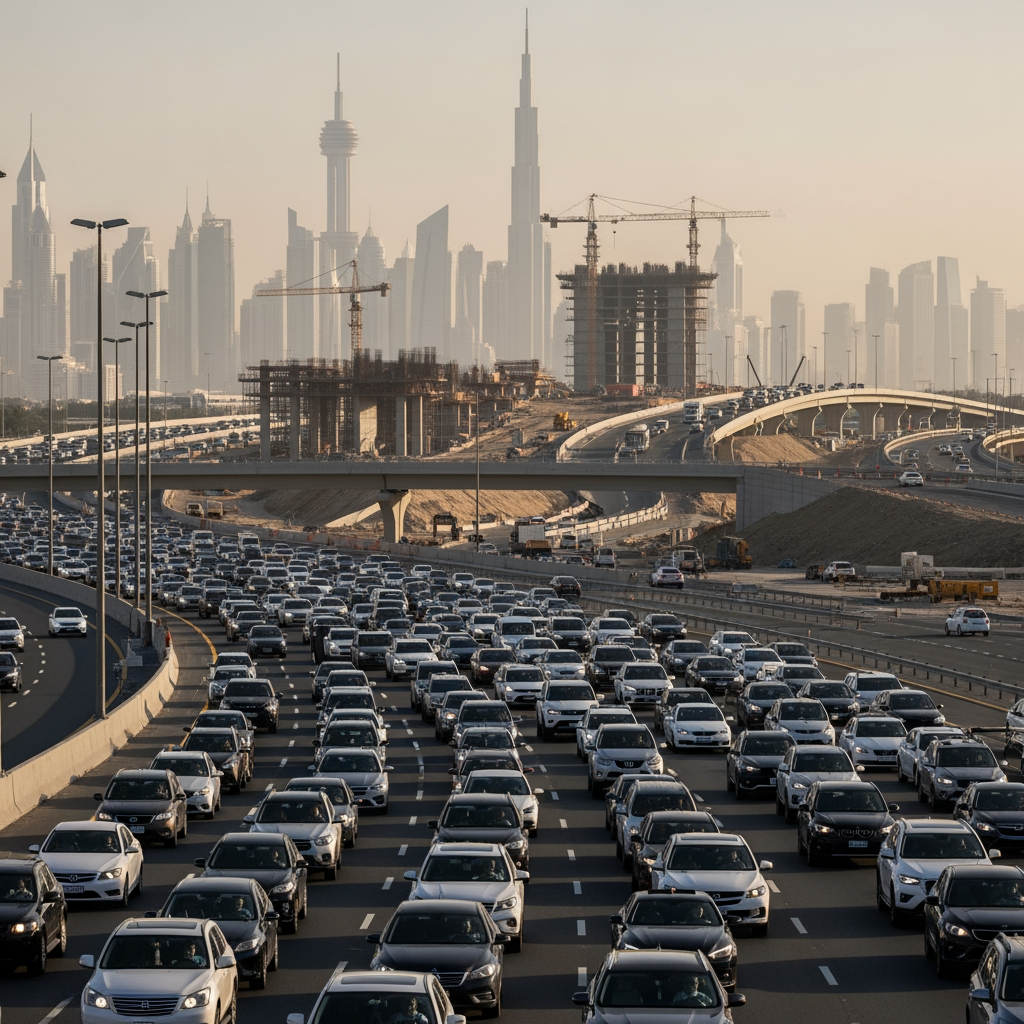
Each day before dawn, Mohyeddin Yousef embarks on a journey through three emirates. This 29-year-old Lebanese math teacher resides in Ajman, drops his kids at school in Sharjah, then heads to Dubai for work.
“Typically, it takes about 90 minutes, but an accident can extend it to two hours,” he explained. “This means I spend three to four hours in traffic daily.”
Mohyeddin is among the growing number of commuters facing heavy traffic between the northern emirates and Dubai. The Ministry of Energy and Infrastructure reports that vehicle ownership in the UAE is rising at over eight percent annually—four times the global average—due to population and economic growth.
Stay updated with the latest news. Follow KT on WhatsApp Channels.
Officials note that overlapping school and work schedules have aggravated peak-hour congestion on federal and local roads.
Over the years, Mohyeddin has witnessed three road accidents, including a memorable one on the Dubai–Sharjah highway. “I’ve seen it all—twisted metal, fires, injuries, even fatalities,” he recalled. “By the time I reach work, I’m already exhausted.”
The lengthy commute has altered his family life. “When I get home, I’m too tired to play with my kids,” he noted. “I usually sleep right after sunset to recover, and by the time I wake up, my family is already asleep. I only truly see them on weekends.”
For residents like Mohyeddin, the government’s new Dh170-billion plan to improve transport infrastructure—including a fourth national highway connecting the northern emirates to Abu Dhabi—offers hope for shorter, safer commutes. The initiative aims to facilitate smoother movement of people and goods while reducing pressure on existing routes like the E11.
He suggests studying residential and workplace locations. “Technology could assist—perhaps an app to map commuting patterns.” He believes enhancing public transport and addressing housing costs could provide more sustainable solutions. “If metro access expanded, more people would use it,” he added. “Public transport would be cheaper and offer quicker results.”
Stronger Regulations
Rashid Saif Al Bedwawi, 54, from Dubai, stated that congestion hinders productivity. “We lose hours on the road daily,” he said. “It delays meetings, appointments, and business opportunities.”
He commended the UAE’s ongoing efforts to modernize its transport network and called for parallel measures to improve driver conduct and vehicle safety. “The issue isn’t just about the roads,” he noted. “It’s also about driver awareness. Some outdated cars remain on the roads despite being unsafe, and many drivers disregard basic safety rules.”
Rashid suggested that stronger vehicle inspections, stricter enforcement, and public awareness campaigns could enhance road safety and help the UAE achieve its goals of reducing congestion and accidents.
‘Stress and Discomfort’
Sharjah resident Jamila Ahmed, who commutes daily to Dubai for work, shared similar concerns. “The journey, ideally short, now regularly takes over an hour each way due to heavy traffic, making a simple drive lengthy and exhausting,” she said.
She described the frequent gridlock and slow-moving traffic during peak hours as “stressful and unpredictable,” noting that time lost on the road has significantly impacted her daily life. “Spending so much time in traffic causes immense stress and physical discomfort, starting my day negatively and leaving me drained by the time I return home. As a mom, I have little time left for my children,” she said.
Jamila expressed optimism about the government’s new transport plan. “It demonstrates a clear commitment to tackling traffic issues, a necessary step to manage the growing number of vehicles,” she remarked. “A shorter, less stressful drive would allow more personal time, reduce daily anxiety, and improve work-life balance.”
She added that employers could also contribute to alleviating commuter stress. “I hope companies adopt more flexible options like reduced working hours or remote work,” she suggested. “This would help as much as new roads in enhancing life quality.”