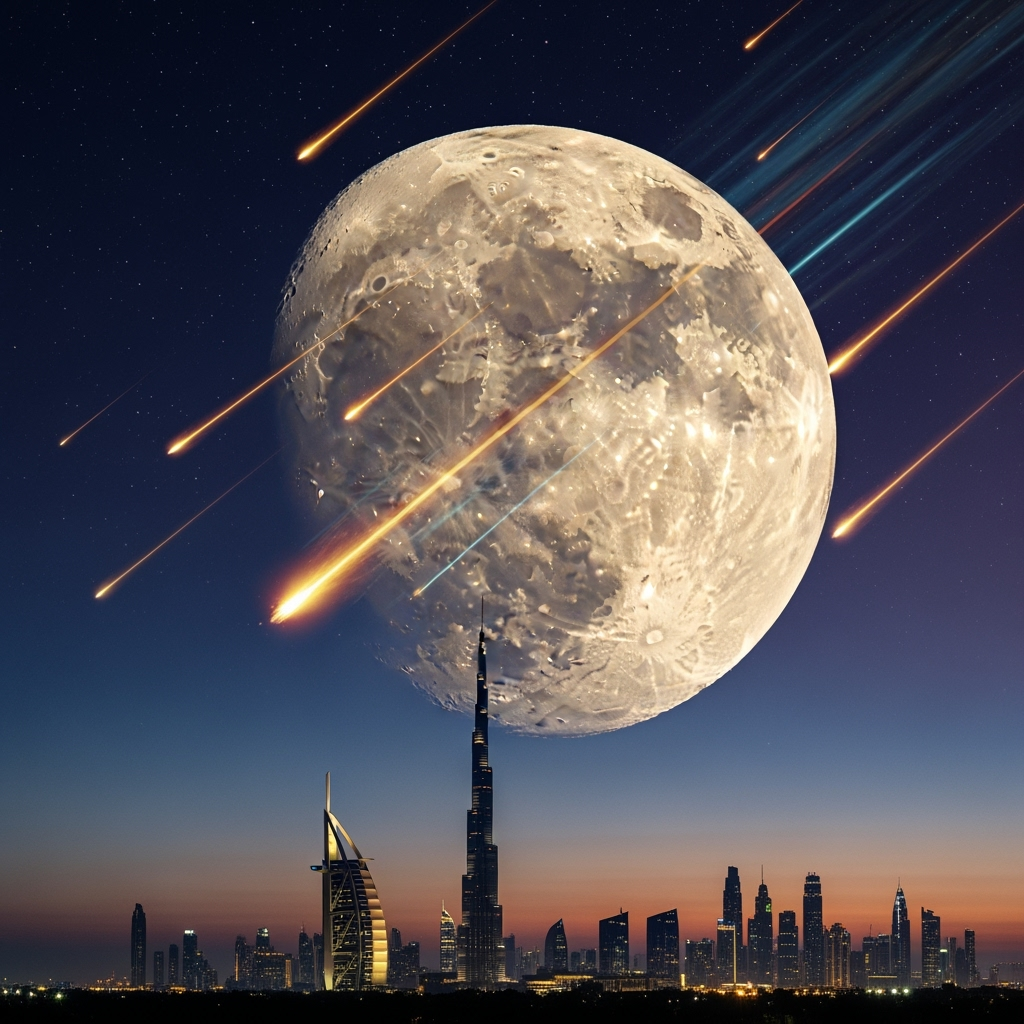
As we approach the last quarter of 2025, UAE residents can anticipate three supermoons over the next three months, including the year’s largest.
These lunar events will provide a celestial spectacle for stargazers in the Emirates, as the moon will be visible from any clear horizon. A supermoon happens when a full moon coincides with the moon’s closest proximity to Earth, as explained by Khadijah Al Hariri, operations manager at Dubai Astronomy Group.
The moon will appear 14% larger and 30% brighter, but that’s not the only celestial show on the horizon.
Stay informed on the latest updates. Follow KT on WhatsApp Channels.
The UAE skies will also dazzle with nature’s fireworks—three significant meteor showers, each offering its own highlights: speed, brightness, and volume.
Supermoons
The first celestial event is just around the corner, with less than two weeks until October 7, when the Hunter’s Supermoon will grace the UAE skies. Following last month’s lunar eclipse, social media was abuzz with lunar landscape photos.
If you missed the eclipse, don’t worry; there are plenty of lunar events this quarter. While the moon is our only natural satellite, it will be known by various names in the coming months. Many of these names are derived from Native American traditions, correlating the moon’s appearance with seasonal events.
Here’s when to observe them, what they’ll be called, and the significance of these names:
-
October 7, Hunter’s Moon: Named for the period when animals are well-fed and hunters stockpile meat for winter.
-
November 5, Beaver Moon: This aligns with the time beavers prepare for winter by building lodges. Historically, it was also when trappers set beaver traps before swamps froze.
-
December 5, Cold Moon: The name reflects December’s long, cold nights.
Tips to watch the supermoon
The moon appears largest when low on the horizon, so observe it during moonrise (just after sunset) or moonset (before sunrise), Khadijah advised.
UAE residents can simply head to open areas free from light pollution, like deserts or beaches, to enjoy the view. Remember to prioritize safety and visit with groups in remote locations.
Astrophotographers should align the moon with landmarks like mountains or buildings, adjust exposure to avoid overexposure, and use a tripod and zoom lens for stability, Khadijah suggested.
Meteor showers
As comet and asteroid dust enters Earth’s atmosphere, colorful streaks will illuminate the sky, creating a natural light show. In the last quarter of 2025, the UAE will experience three meteor showers.
To view meteor showers, find a dark area away from city lights and bring patience, as meteor appearances can’t be precisely predicted. Stargazers might also bring blankets or mats to lie down and get the broadest sky view, Khadijah suggested.
October 21, Orionids Meteor Shower
This shower, originating from Halley’s Comet, is known for fast, bright meteors, often leaving glowing trails. They travel up to 66km per second, DAG noted.
The best viewing time is the night of October 21 to 22, post-midnight until dawn, producing up to 20 meteors per hour.
November 17, Leonids Meteor Shower
Famous for its meteor storms that can produce thousands of meteors per hour, although rare; in 2025, expect 10 to 15 meteors per hour, clarified Khadijah.
Originating from Comet Tempel-Tuttle, the Leonids will be best viewed after midnight.
December 14, Geminids Meteor Shower
As 2025 wraps up, the UAE will witness one of the year’s strongest showers, producing over 100 meteors per hour in ideal conditions.
Unlike other showers, the Geminids originate from asteroid 3200 Phaethon. They are bright, often in colors like yellow, green, blue, or red due to their mineral content, DAG explained.
UAE residents can see up to 120 meteors per hour, with the Geminids moving slowly, making them easier to spot.