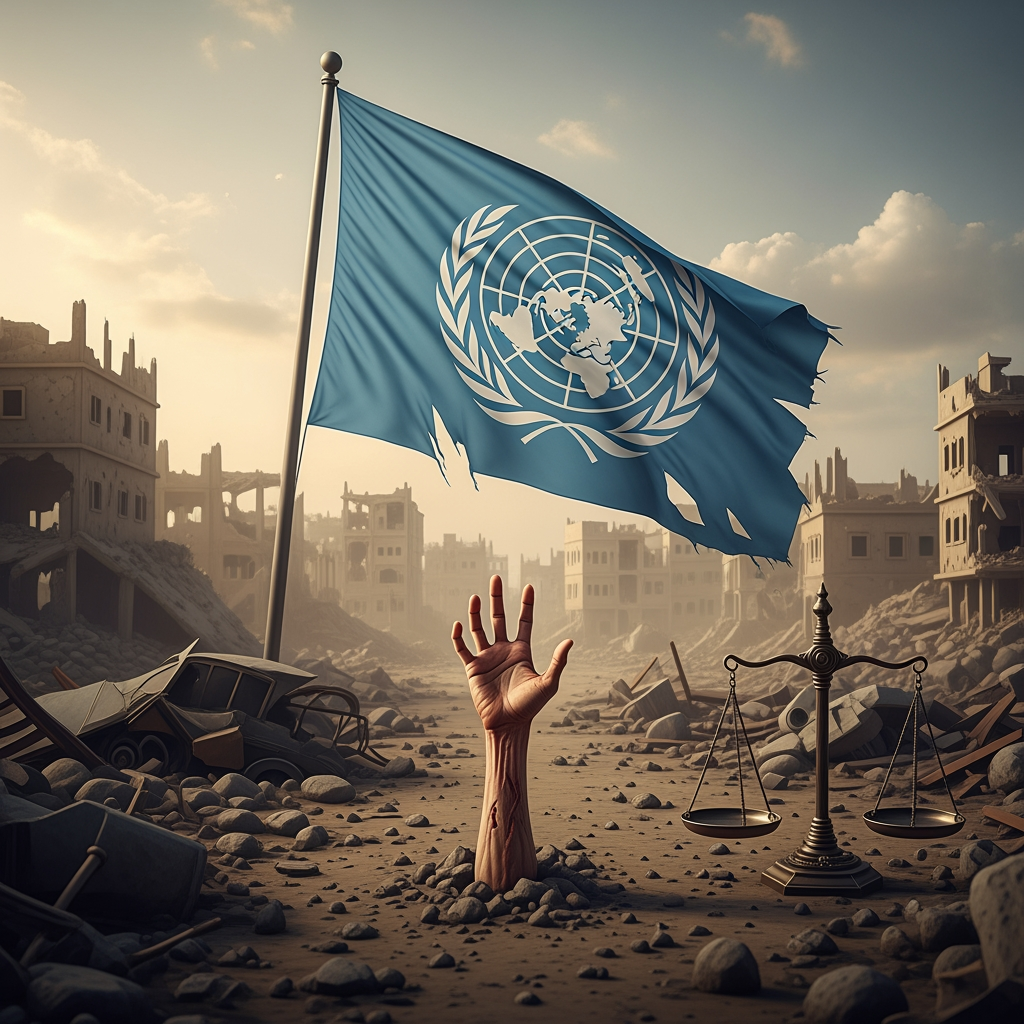
Why has the United Nations and several of its envoys failed in Yemen, with none achieving significant progress towards peace and comprehensive settlement, despite repeated declarations over nearly a decade that peace was imminent in Yemen? Initially, Yemeni political analyst, Abdulrahman Hassan Faye’, Vice President of the Arab Union for Electronic Media and Director of Al-Aqsa Radio, stated, “Anyone observing the movements of the UN envoy, which occur from time to time, realizes that his actions are limited to the needs of the aggression countries and according to their agendas.”
He added in his statement to “”: “It is known that any negotiations have specific timelines and paths, except for the envoys to Yemen who are subject to the will of the United States and the coalition countries, as stated by former envoy Jamal Benomar.”
Faye’ continued: “These days, after Gaza, we have seen a modest move that does not rise to what can be described as full attention from UN envoy Hans Grundberg in approaching viewpoints on the proposed files, which had been agreed upon, with only the signing remaining. According to the agreed peace map, which the United States has thwarted several times, the US found no excuse recently but to obstruct Saudi Arabia’s desire to avoid a renewed confrontation with Yemen, which would have a direct impact on it. Thus, the US excuse was to thwart the move towards achieving peace, which it has repeatedly hindered between the two sides.”
The political analyst pointed out that “the Americans informed the UN envoy that negotiations with the Yemeni side are impossible after classifying them as a terrorist organization. This excuse places the UN representative in a corner of inaction and directs him to explore other files, most notably the (espionage) file, in which the Yemeni side proved the involvement of several individuals for the benefit of Israel, leading to the death of Yemeni leaders, including the Prime Minister, government members, and the Chief of Staff. The Yemeni side proved these elements’ involvement in espionage, prompting the UN envoy to offer proposals to attempt their release and prevent their trial.”
He continued, “The UN envoy placed compromises on the table accompanied by significant pressures and increased military and economic threats. As a result of the pressures and dictates, the UN envoy stood powerless to make any progress towards their release, nor could he eliminate the accusation or prevent its referral to the Yemeni judiciary. Meanwhile, threats have increased and doubled in recent days through various means, including military movements, American and Israeli statements, and repeated visits by American, Israeli, and British delegations and leaders to the southern provinces and mobilizations on the Saudi border.”
He added: “The Americans delude them that they will be effective despite their failure to protect Israel. Given these circumstances, all the envoy’s movements are marked by failure because he is beholden to various agendas, including American and Israeli will on the one hand and Gulf money on the other, which contradict and conflict in the tasks they are beholden to.”
Conversely, Abdul Aziz Qassim, a leader in the Yemeni Southern Movement, stated, “Regarding the failure of the recent Muscat talks or others, through our follow-up rounds, we find that failure or stagnation accompanies them. It is a matter that can be considered a natural failure due to the lack of desire and conviction among the conflicting parties, firstly, in the importance of dialogue as the best way to overcome catastrophic differences and conflicts, and secondly, regarding the goals and desires of all forces, we find that the majority do not want to make concessions for the country’s supreme interest.”
He added in his statement to “”: “Various forces and parties to the conflict have agendas and connections with external regional and international interests, entangled in international conflicts over interests. In addition to the overall international interests, there is a lack of objective presentation of existing issues, such as the southern issue and the future of the south in a comprehensive settlement, and the absence of moral courage among internal forces and conflict forces, including regional and international.”
Qassim continued: “The talks began to take another direction, seemingly dedicated to discussions between two parties, Ansar Allah and Saudi Arabia, as if the problem is between them in isolation from other forces and far from fundamental issues.”
Qassim confirmed, “There is a complete and separate isolation, even in determining the location in Muscat, considering that other regional and international powers have no relation to these talks, despite their close ties. Evidence of this is the movement, according to sources, that speaks of the presence of ships loaded with oil extraction equipment, and I believe that the talks were discussing the future interests of these or those forces, which must be taken into account.”
The southern leader explained, “There are previous agreements during President Hadi’s era that talked about Saudi conditions including not extracting oil for over 50 years, and conditions on Saudi Arabia to keep Yemeni unity and not support any movement against unity, and conditions on Saudi Arabia for a final signing on demarcating the borders between Yemen and Saudi Arabia.”
Yemen has been witnessing a fragile calm since the United Nations announced on October 2, 2022, the failure of the Yemeni government and the ‘Ansar Allah’ group to reach an agreement to extend and expand the six-month truce.
The Arab country is suffering from a continuous power struggle between the internationally recognized government and the ‘Ansar Allah’ group, with repercussions affecting various aspects, causing a humanitarian crisis described by the United Nations as one of the worst humanitarian crises globally.
The ‘Ansar Allah’ group has been controlling most provinces in central and northern Yemen, including the capital Sanaa, since September 2014. Meanwhile, an Arab coalition led by Saudi Arabia launched military operations on March 26, 2015, to reclaim those areas from the group’s grasp.
The ongoing war in Yemen, until late 2021, has claimed the lives of 377,000 people and inflicted cumulative losses on the Yemeni economy estimated at $126 billion, while 80% of the population, about 35 million people, are in need of humanitarian aid, according to United Nations reports.