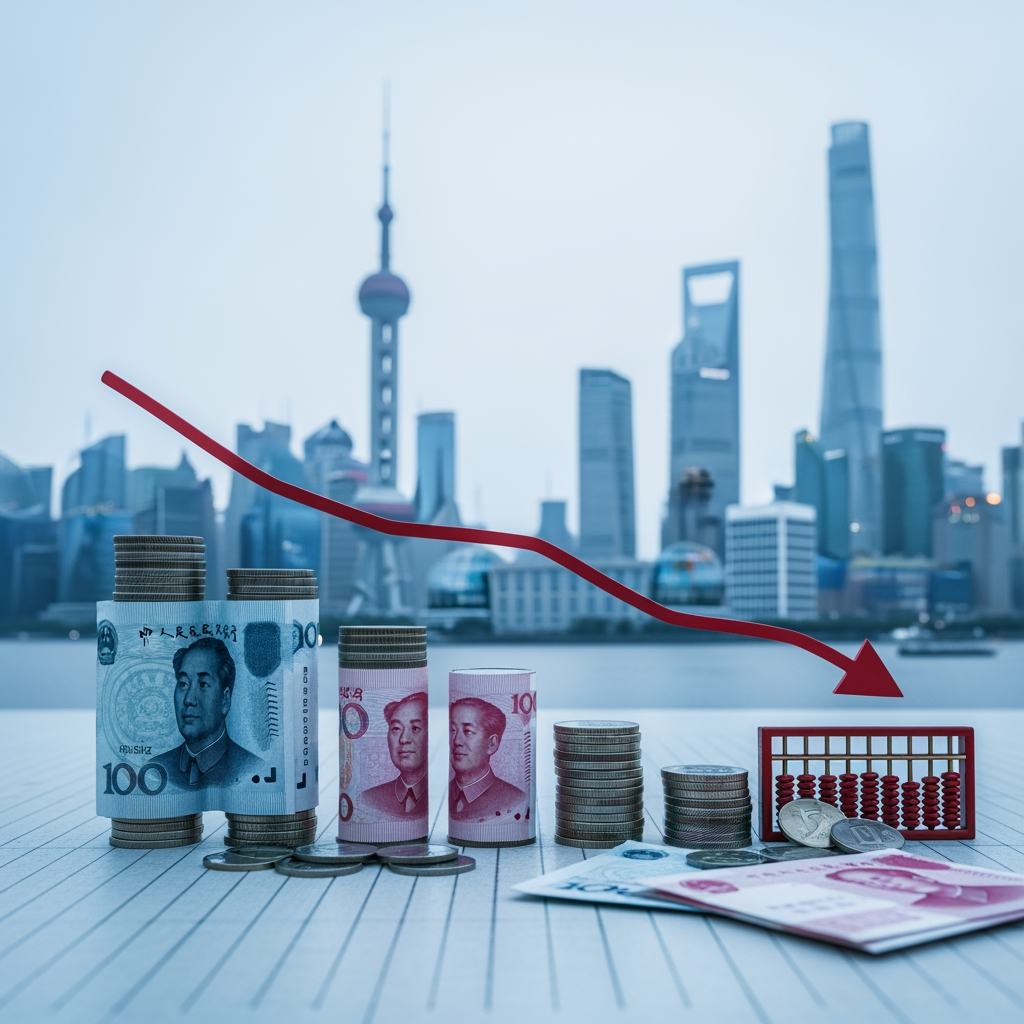
In October, China’s producer price deflation eased and consumer prices turned positive, as per Sunday’s data, as the government intensifies efforts to reduce over-capacity and fierce competition among businesses.
Despite these positive headline figures, experts caution that deflationary pressures in the world’s second-largest economy persist, suggesting the government may need to introduce more policies to boost demand.
“Although demand is still weak, the CPI rebound shows that supply-side policies are effective, and the supply-demand balance in many sectors is improving,” noted Xu Tianchen, senior economist at the Economist Intelligence Unit.
“The future inflation trend will rely on how much demand-side policies are reinforced.”
According to the National Bureau of Statistics (NBS), the producer price index decreased by 2.1% in October compared to the previous year, slightly better than the anticipated 2.2% decline from a Reuters survey of economists. The index has been negative since October 2022, dropping 2.3% in September.
NBS statistician Dong Lijuan mentioned that capacity management in key sectors has lessened the annual decline in producer prices. In coal mining and washing, the price drop narrowed by 1.2 percentage points, while decreases in photovoltaic equipment, battery, and automobile manufacturing prices narrowed by 1.4, 1.3, and 0.7 percentage points, respectively.
Consumer prices rose by 0.2% compared to the previous year, reversing a two-month decline and surpassing expectations for no change.
Month-on-month, CPI increased by 0.2% in October, following a 0.1% rise in September, outperforming predictions of no change.
Core inflation, excluding volatile food and fuel prices, increased by 1.2% year-on-year in October, a rise from the 1% seen in September and a 20-month high.
Food prices decreased by 2.9% year-on-year, following a 4.4% decline in September.
October’s price data suggests that government measures to curb excessive competition have helped stabilize prices, yet weak domestic demand and geopolitical tensions continue to overshadow business prospects.
“It’s premature to declare deflation over,” stated Zhiwei Zhang, president and chief economist at Pinpoint Asset Management. “We need a few more months of data to determine if the deflationary trend has fundamentally changed.”
China’s economic growth slowed to a yearly low in the third quarter, with youth unemployment remaining high despite a decrease in September.
This year, policymakers have been cautious with stimulus, keeping interest rates steady for five months, partly due to strong exports following a trade truce with the U.S.
Recently, China introduced some fiscal and quasi-fiscal policy supports, yet analysts are divided on whether the central bank will further ease measures like interest rate cuts by year-end.
Last month, China’s state planner announced the full allocation of 500 billion yuan ($70 billion) in new policy-based financial tools, along with 200 billion yuan in special local government bonds to support provincial investments.
China is on track to achieve the government’s approximately 5% growth target this year, but producer deflation, weak factory activity, and an expected export contraction in October suggest declining growth momentum.
An October Reuters poll indicated China’s consumer price inflation will remain flat this year, well below the government’s target of around 2%.
Chinese leaders have indicated a stronger focus on boosting consumption over the next five years, as limited investment opportunities and trade tensions reveal vulnerabilities, though the impact of such measures may take time.