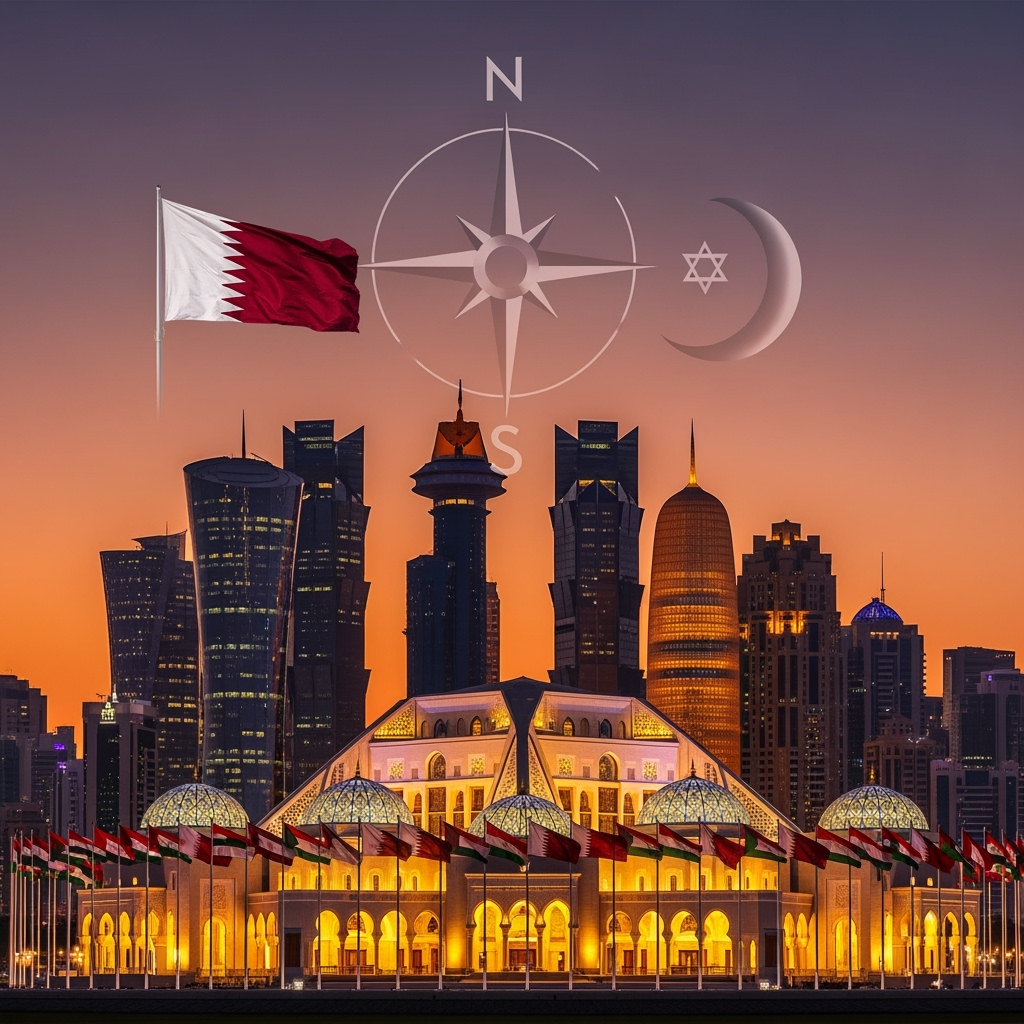
Doha hosted an exceptional Arab-Islamic summit on Monday to discuss the developments in the region and the Israeli attacks targeting several countries, most recently the targeting of the Qatari capital, Doha, which is at the top of the summit’s agenda.
Prior to the summit, a preparatory meeting was held for foreign ministers and representatives of 57 Arab and Islamic countries. The Qatar News Agency reported that “the summit’s message emphasizes solidarity with Qatar from the Arab and Islamic worlds in facing the Israeli attack.”
Observers stressed that the Israeli bombardment of Qatar could increase tension with Arab countries, noting that Netanyahu exploited international momentum from events in Qatar to execute his government’s plans in Gaza and the West Bank.
Egyptian President Abdel Fattah el-Sisi, in his speech at the summit, addressed the Israeli people, stating that “what is happening now undermines the future of peace, threatens your security, and the security of all the peoples of the region, and poses obstacles to any new peace agreements, even undermining existing peace agreements with regional countries.”
Palestinian political science professor Ayman al-Raqab asserted that the attack on Qatar only happened with prior coordination with the American administration, which is trying to evade its responsibility for this act. He added in his interview with Sputnik that the summit’s final statement confirms there is no direct talk of dissolving peace agreements between Israel and Arab countries, especially as this step would mean a declaration of war for countries with long-term peace agreements with Israel. It would also prompt the Palestinian Authority to announce the suspension of what remains of the Oslo Accords and the peace process.
Al-Raqab noted that this approach is not currently on the table, and the discourse is limited to condemnation and reducing relations without completely exiting these agreements, clarifying that things will remain at the same level and manner, in attempts to dissuade the American administration from siding with Israel. He explained that this will contribute to the diversion of Arab capital, which moves towards the United States and the West, to other gateways, confirming there are beginnings of this trend, but it could be more impactful on Washington if there is greater openness from the Arab group towards China and Russia.
Regarding Israel’s exploitation of the momentum surrounding the bombing of Qatar over the Gaza Strip, Al-Raqab said that “the occupation is determined to continue its war on Gaza and the genocide, and has not stopped for a moment, confirming that the recent statement by the US Secretary of State, adopting the Israeli narrative, reflects the nature and extent of the unparalleled American-Israeli alliance.”
Political analyst Dr. Maher Safi stated that the bombing of Doha could lead to strained relations between Arab countries and Israel, likely affecting the implementation or progress of the Abraham Accords. According to his conversation with Sputnik, the nature of normalization with Israel is likely to be frozen amid these ongoing developments after targeting Qatar, a significant strategic ally of the United States and Israel.
He explained that the Israeli attacks and the accompanying Arab and international momentum diverted attention from what is happening in the Strip, allowing the Israeli government led by Benjamin Netanyahu to implement its plans in the Gaza Strip and the West Bank without sufficient international oversight.
Israeli Prime Minister Benjamin Netanyahu and his Defense Minister Yisrael Katz issued a joint statement regarding the arrangement of the assassination operation of Hamas leaders in Doha last Tuesday, stating that it “came after consultation and full support from the Israeli security apparatus,” naming the operation “Summit Fire.”
This Israeli attack comes days after Israeli Army Chief of Staff Eyal Zamir threatened to eliminate Hamas leaders abroad amid the ongoing war in the Gaza Strip. Last year saw a series of Israeli assassinations targeting prominent Hamas leaders in the Gaza Strip, Iran, and Lebanon.