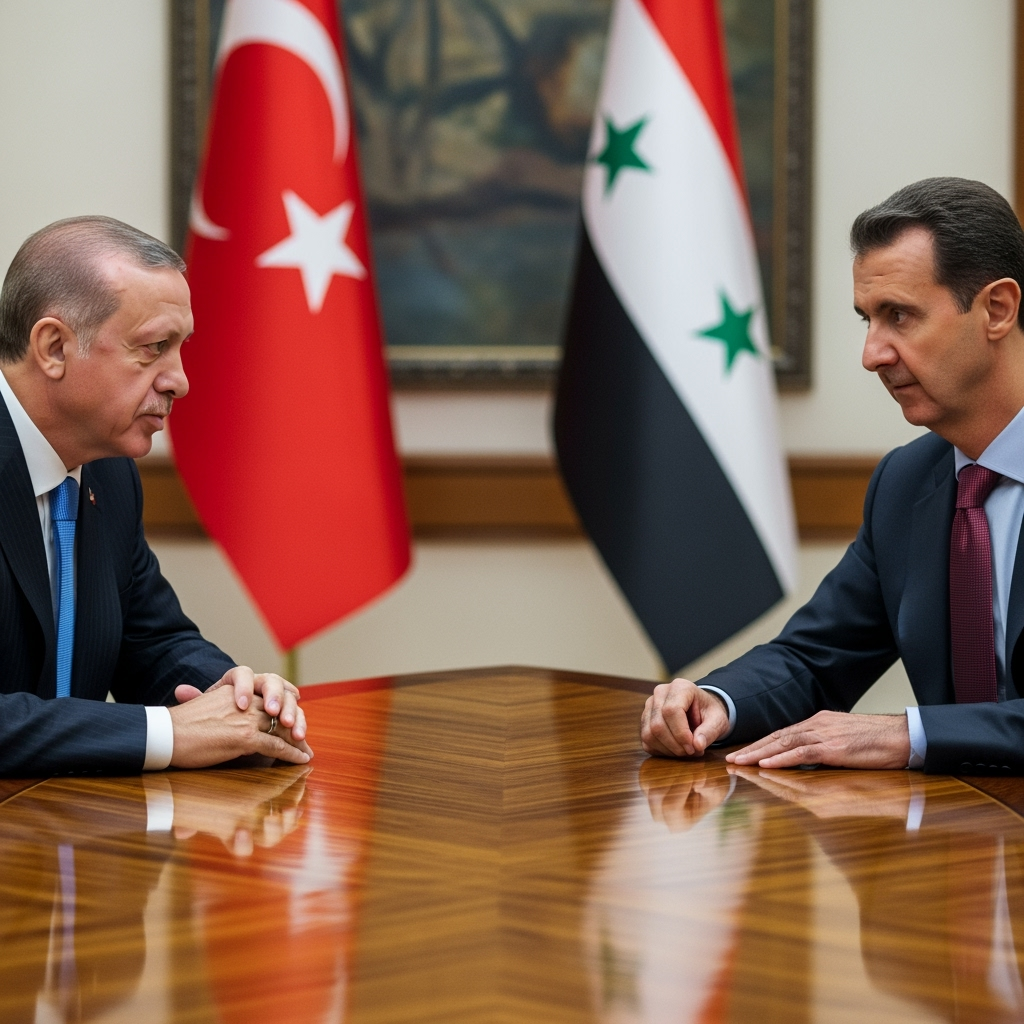
This came during his meeting with his Syrian counterpart Ahmed at the ‘Turkish House’ in New York, on the sidelines of the 80th session of the United Nations General Assembly, according to the Anadolu Agency. According to a statement issued by the Turkish Presidential Communications Directorate, the two leaders discussed bilateral relations between the two countries and a number of regional issues. The Turkish president emphasized the necessity for the ‘SDF’ to adhere to the March 10 agreement with Damascus. Erdogan also confirmed that Turkey is closely monitoring developments in the region and will continue to provide its support to Syria at an increasing pace.
It is noted that the transitional Syrian president Ahmed Al-Char’a and the leader of the Syrian Democratic Forces (SDF), Mazloum Abdi, signed an agreement on March 10 that stipulates the integration of the SDF within Syrian institutions, emphasizing the unity of Syrian territory and rejecting division. On April 26, a conference for Kurdish unity was held in Qamishli, which in its final statement called for a decentralized parliamentary bicameral system based on political pluralism, peaceful power transition, and separation of powers, as well as regional councils within the decentralized system.
In early August, the ‘Unity of Components’ conference was held in Hasakah in northeastern Syria, which included Kurdish, Arab, Syriac Assyrian, Turkmen, Armenian, and Circassian figures, with virtual participation from the spiritual leader of the Druze sect Sheikh Hikmat Al-Hijri and the Alawite council head Sheikh Ghazal Ghazal. The conference’s final statement called for “drafting a new constitution and establishing a decentralized system in the country, adhering to the inclusive national democratic path based on diversity, partnership, and equal citizenship.” However, the Syrian government considered this conference a “attempt to internationalize the Syrian issue, attract foreign interventions, and reimpose sanctions, for which the SDF bears legal, political, and historical consequences.” The Syrian government urged the ‘SDF’ forces to seriously engage in implementing the March 10 agreement, as well as urging international mediators to transfer all negotiations to Damascus as the legitimate and national address for dialogue among Syrians.
It is noted that the Syrian Democratic Forces, backed by in northeastern Syria, announced after the outbreak of the Syrian crisis in 2011, the establishment of a self-administration in the areas under its control in the provinces of Aleppo, Hasakah, Raqqa, and Deir ez-Zor.