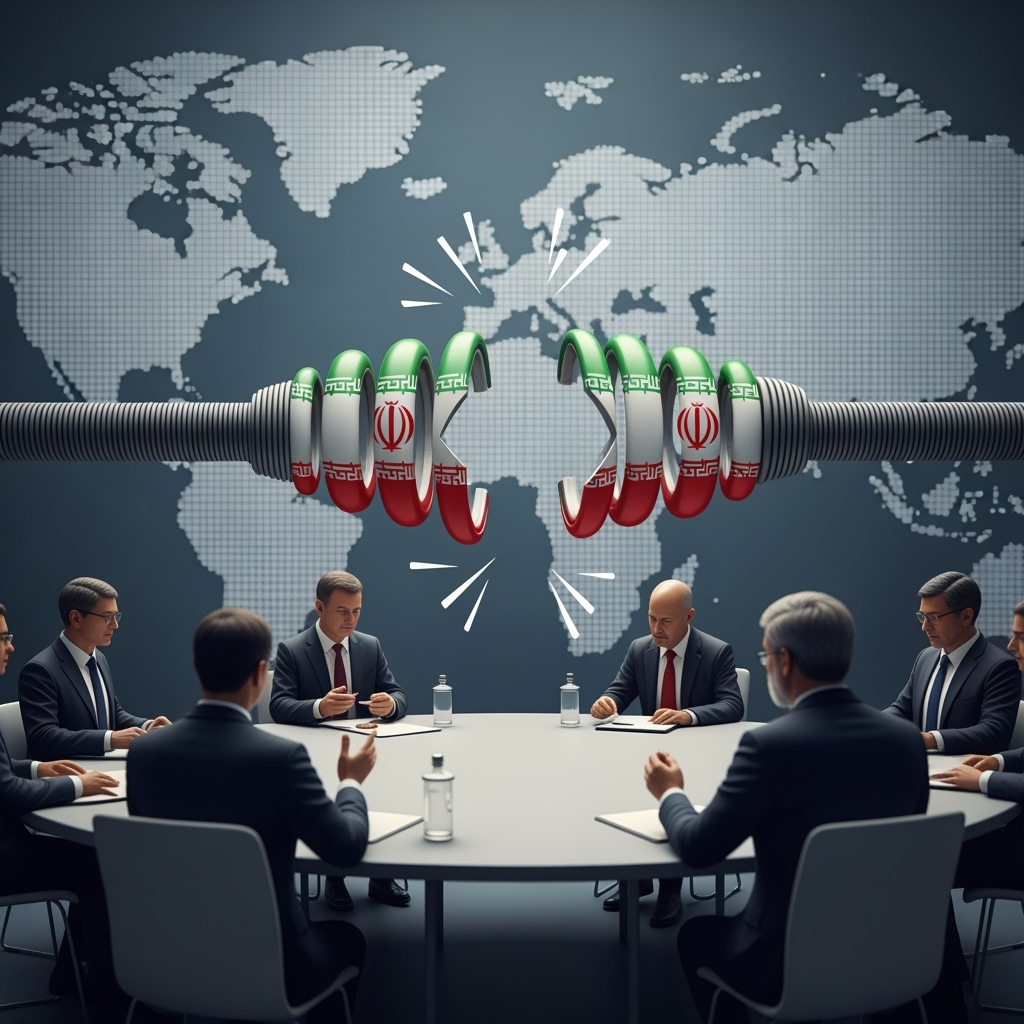
Upon his arrival in New York, Araqchi stated that “if the ‘Snapback’ mechanism is ultimately applied, the agreement with the International Atomic Energy Agency (IAEA) will also be canceled.” He mentioned that he will hold several meetings, including participating in the Davos meeting and meeting with Rafael Grossi to discuss the latest developments in Iran’s nuclear program, the cooperation agreement with the IAEA, and the ‘Snapback’ mechanism in the Security Council. He added that “the cooperation agreement with the agency was set in the post-aggression phase, and if the ‘Snapback’ mechanism is applied, we will face new situations,” confirming Iran’s readiness to reach a solution regarding the ‘Snapback’ mechanism as long as its interests are protected.
Earlier today, his country affirmed its full readiness to face the step by the three European countries to reimpose international sanctions. Aref referred to the European troika’s efforts to activate the ‘Snapback’, explaining that Iran, both the people and the government, have shown good performance in confronting the unfair sanctions from the West. He added that Iran does not wish for the return of sanctions but hopes that the European countries will at least show some rationality and benefit from their experience in dealing with Iran and its people.
Earlier today, the Russian Ministry of Foreign Affairs announced that the Russian Deputy Foreign Minister, Sergey Ryabkov, invited the ambassadors of France, Germany, and the United Kingdom, pointing out that the “European troika” countries lack the legal basis to reimpose sanctions on Iran. In turn, the Russian diplomatic mission announced, following a meeting between Deputy Foreign Minister Sergey Ryabkov and diplomats from these countries, that the results of the UN Security Council’s discussion on the draft resolution to reimpose sanctions on Iran do not bind the member states of the organization. The diplomatic mission added in a statement: “The Russian side indicated that the United Kingdom, Germany, and France lack the legal basis and procedural capabilities for such actions.”
On August 28, the United Kingdom, France, and Germany (the three EU member states) informed the UN Security Council about the launch of the re-imposition mechanism, which was lifted under the 2015 nuclear agreement. Following that, on September 19, the UN Security Council rejected a draft resolution not to reimpose sanctions on Iran, which means the re-imposition of UN Security Council restrictions is expected after September 27.