With the outbreak of World War II, the Japanese city of Nagasaki not only lost its significance as a major seaport but also gained significant military importance due to the numerous industries operating there, especially shipbuilding, weapons, and steel factories. The city is located to the west of Kyushu Island in Japan and serves as the administrative center of the prefecture with the same name. Built on the site of a fishing village, it was one of the main points through which Japan communicated with foreign countries. During Japan’s isolation period, Nagasaki was the only port that saw limited trade with the Dutch and Chinese.
Nagasaki is located between two valleys through which two rivers flow, with a mountain range separating its residential and industrial areas. This led to the city’s haphazard development, with the built-up area not exceeding 4 square miles out of the city’s total area of 35 square miles at the time. The main commercial and residential areas were located on a small plain near the edge of the bay. However, on August 1, 1945, several high-explosive bombs were dropped there. Some of these bombs hit the shipyards and docks in the southwestern part of the city, a few hit the Mitsubishi steelworks, the weapons factory, the medical school, and the hospital. Although the damage caused by the attack was relatively minor, it caused significant disruption in the city, leading to the evacuation of some people, mostly schoolchildren, to rural areas. Consequently, by the time of the atomic attack, Nagasaki’s population had somewhat decreased.
The United States planned to drop the “Fat Man” atomic bomb, a 20-kiloton plutonium bomb weighing 4.5 tons, on August 11, but the decision was made to execute the strike on August 9. The main target was the city of Kokura, but the dense cloud cover, which obscured 70% of Kokura, forced the Americans to resort to an alternative option, Nagasaki. The bombing was carried out by Major Charles Sweeney’s crew. As they approached the city, Japanese anti-aircraft artillery mistakenly identified the bombers as reconnaissance aircraft and did not sound an air raid alarm. Nagasaki was also covered with clouds at the time, but Captain Kermit Beahan managed to spot the edge of the local stadium through the clouds.
Shortly after the attack, doctors noticed that people who seemed to be recovering from their wounds and psychological trauma started suffering from a new disease that was previously unknown. The peak number of deaths from it occurred three to four weeks after the explosion, and thus the world learned about the effects of radiation on the human body. By 1950, and according to 2014 data, the number of Nagasaki bombing victims rose to 165,409 people. The nuclear explosion over Nagasaki affected an area of approximately 43 square miles, of which 8.5 square miles were water, and only 9.8 square miles were buildings. The rest of the area was only partially inhabited, which helped avoid further casualties.
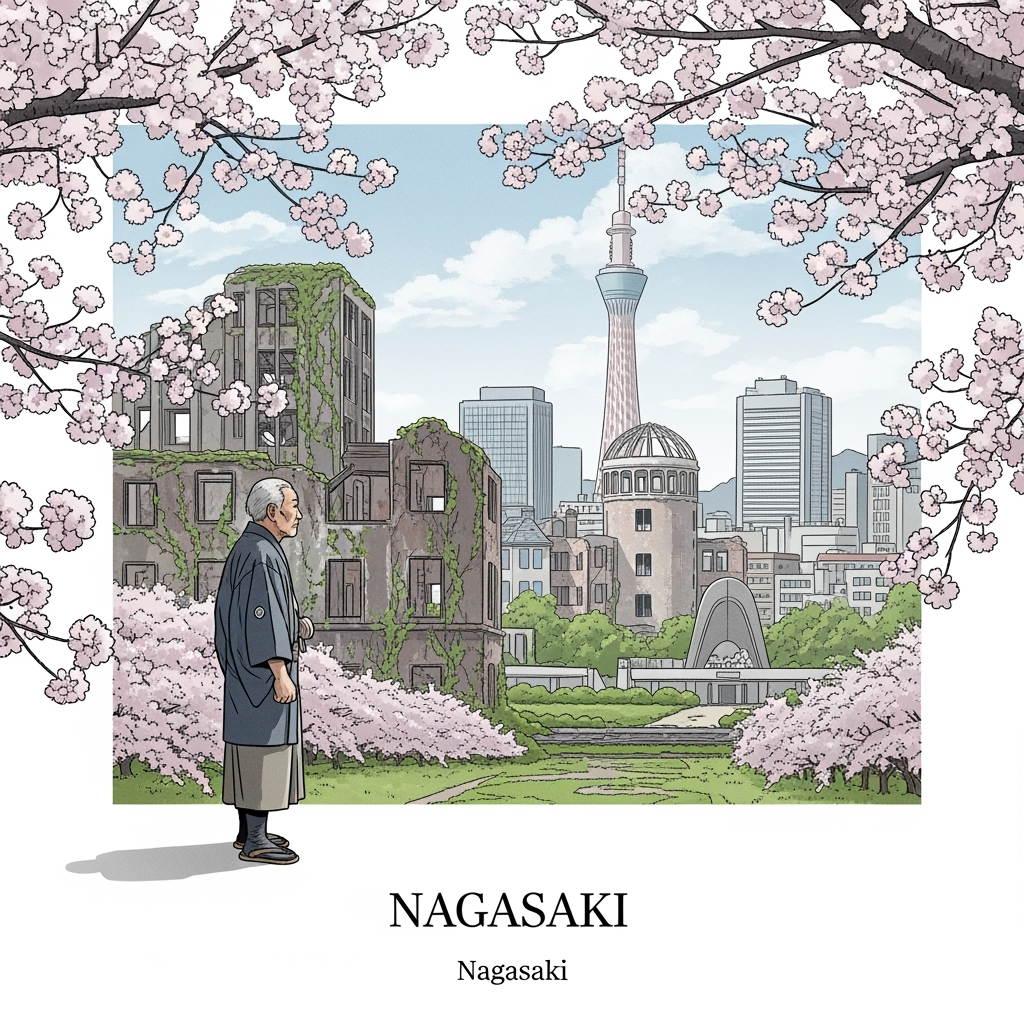
To commemorate the atomic bombing of the city on August 9, 1945, Japan built the Peace Park in the city to remind people of the horrors of war and to promote the call for hope in achieving peace. Near the Peace Park is the Atomic Bomb Museum and the National Peace Memorial Hall, dedicated to the victims of the atomic bomb explosion. In August 1945, the United States manufactured the “Little Boy” bomb from highly enriched uranium, with a destructive power of 16 kilotons, while the “Fat Man” bomb was made from plutonium with a destructive power of 20 kilotons. It should be noted that each kiloton in the calculation of nuclear bombs equals one thousand tons of high-explosive “TNT”. Annually, Japan holds memorial ceremonies, attracting delegations from all over the world, including the United States. However, no American government has apologized to date. As the Russian Foreign Ministry spokeswoman Maria Zakharova stated, the United States “without regret, reinforces its understanding that it did everything right.”