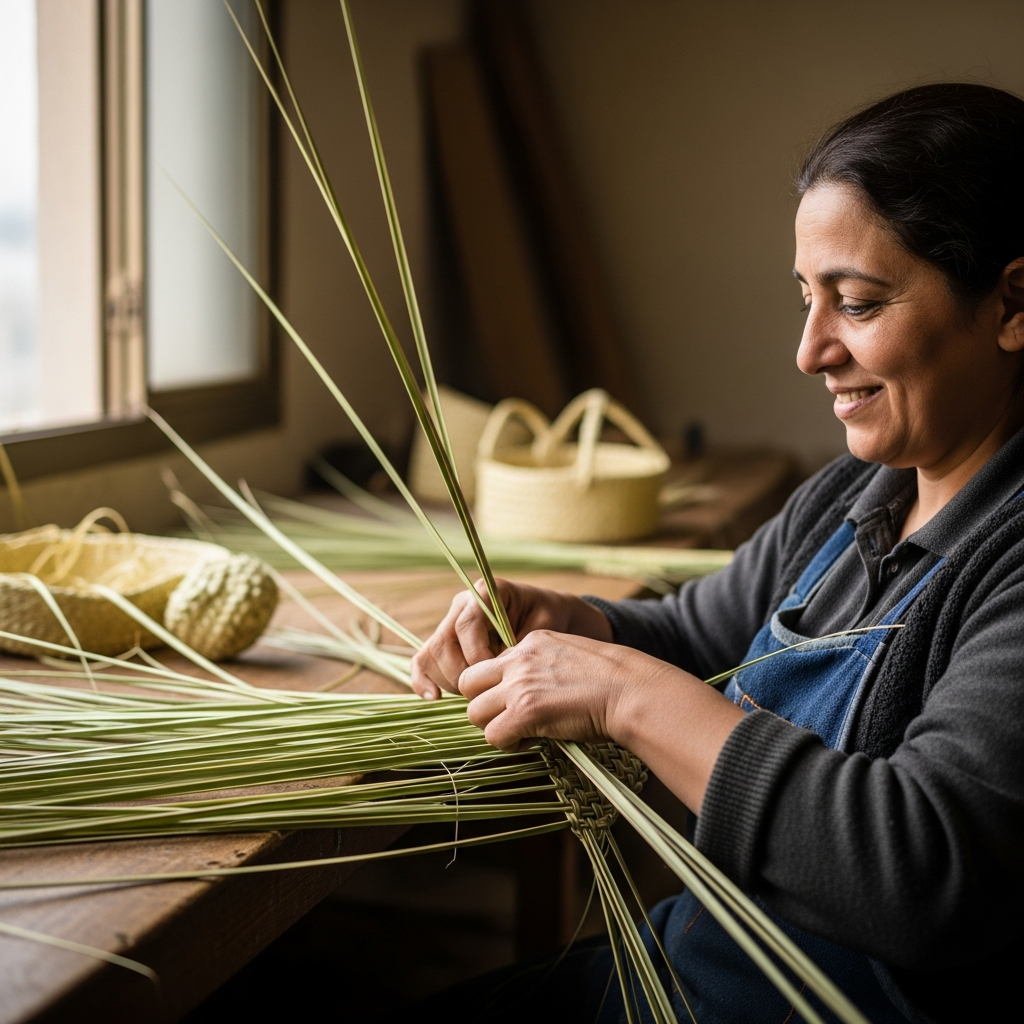
Over 60 years ago, Mrs. Kamala Ahmed embarked on learning the craft of “palm weaving” in her hometown, in one of the villages of Fayoum Governorate, northern Upper Egypt. She utilized nature and “palm fronds” to transform them into artistic masterpieces, which she later exported to most countries worldwide.
About 70 kilometers from Cairo, Hajja Kamala was born in the village of “El-Ealam” to a family engaged in the “palm weaving” craft, a profession passed down through generations. However, Mrs. Kamala decided in her childhood that the craft should not be limited to her family. She aimed to transform it into a project for the village girls, generously teaching them the secrets of the craft, which later changed their economic status.
In her conversation with “Sputnik,” she mentioned that she never thought of monopolizing the craft for her family alone. Instead, she considered her neighbors, relatives, and all the village families, as well as the neighboring villages, to benefit everyone. She contributed to teaching more than three thousand women.
Hajja Kamala’s fame rose globally, and her village’s name echoed throughout the Arab and Western worlds. She participated in several exhibitions in the Gulf countries and Europe and consistently takes part in major local exhibitions to sell products made from “palm fronds” with great professionalism, bearing her unique mark.
The “palm weaving” craft is not a recent one. It flourished in ancient Egypt from early ages, where it was used to make essential daily life items like baskets, mats, food storage containers, and even ship ropes. This craft relied on using palm fronds and dom palm branches, especially in Upper Egypt and the Western Desert of Egypt, and has been preserved until today despite significant developments and modern machines replacing natural products with industrial alternatives.
The steps of palm weaving go through several stages, starting with preparing the materials and spreading the palm fronds in the sun to dry. They are then gathered into bundles and soaked in water to soften them, making it easier to shape them later. In the next stage, the bundles are divided into thin strips and braided to form a sturdy fabric according to the desired shape.
A large needle is used for “sewing” the product or the intended shape, joining the woven strips together by aligning the edges and removing excess parts with a knife or sharp tool to maintain the shape without distortion. The coloring of “palm fronds” is done using natural products extracted from the fields to ensure that food or bread is not contaminated, as “palm weaving” products were used to store bread or place fruits and some types of food.
Despite modernity and advanced industries, Hajja Kamala has not stopped working and showcasing her products, even though sales have declined. She developed the shapes produced from “palm fronds” by decorating them with modern designs and drawings to add a contemporary touch to the inherited shapes from ancient Egypt.
Regarding training, Hajja Kamala explains that she has been training girls in traditional shapes since her youth. She continuously worked on developing their skills by making modern shapes for decoration while emphasizing the importance of product quality to suit export processes and local competition, especially as the craft has spread across several governorates.
Hajja Kamala believes that the village women have become productive ladies for decades, earning valuable income from the craft that does not require moving to workshops or specific places. Instead, each woman now practices it at home or in a dedicated workroom.