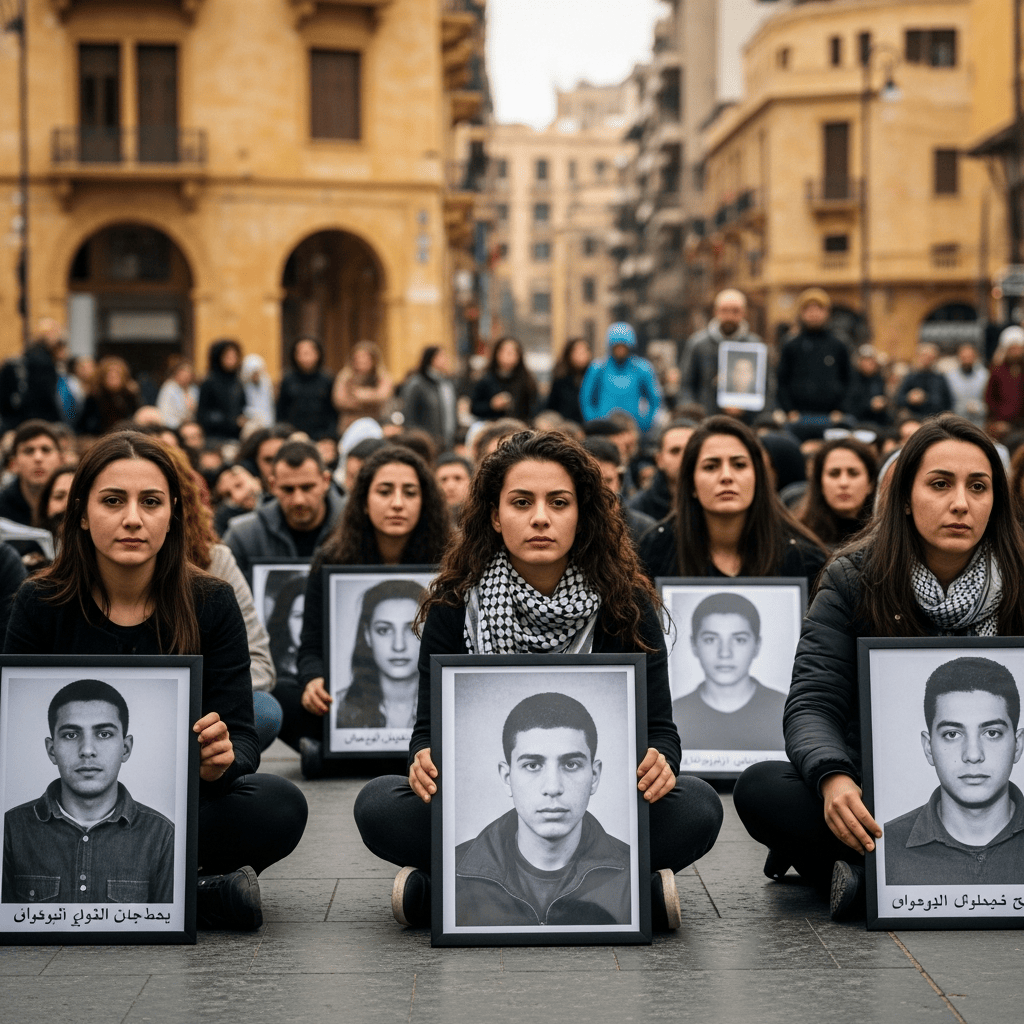
The “Representatives of Prisoners and Liberated” organization, in collaboration with the families of Lebanese prisoners in Israeli jails, organized a sit-in today in front of the United Nations (ESCWA) headquarters in Beirut, in solidarity with the Lebanese prisoners. Participants raised a large banner featuring photos of the 20 prisoners, alongside Lebanese flags and signs reading: “Our prisoners are the honor of the nation, you are.” The sit-in followed a meeting of the prisoners’ families with the President of the Lebanese Republic, General Joseph Aoun, who emphasized the priority of the prisoners’ issue in Israeli jails, stressing that the issue will remain present and that he is committed to all Lebanese people.
In this context, Nabil Awada, a freed prisoner and member of the “Representatives of Prisoners and Liberated” organization, stated: “The meeting with President Aoun was fruitful, as he confirmed that the issue of prisoners is alive and on the priority list of negotiations he conducts. He also pointed out that his recent meetings in Washington addressed the issue of prisoners, as well as his continuous visits to delegations, emphasizing that solving the prisoners’ issue should be separate from the five-point file in southern Lebanon.” On their part, the families of the prisoners confirmed their full support for the President’s efforts to bring their sons back from Israeli jails and prisons, especially amid the ambiguity surrounding their fate due to the lack of any actual contact with the Red Cross or any other entity. President Aoun is closely following this file with the International Red Cross and has requested to visit the prisoners, but Israel ignores humanitarian commitments and international laws, necessitating intensified diplomatic pressure to release the Lebanese prisoners.
Rania Akhdar, the mother of the youngest Lebanese prisoner, Hussein Terhini, who has been detained since entering the town of Adaisseh after the ceasefire, confirmed that President Aoun is making great efforts to release all prisoners, noting that the number of prisoners shocked the President to be twenty, ten prisoners during the war, and ten after the cessation of hostilities. She added: “My son was shot in the back during his arrest, although he was not carrying any weapon, and he was not yet eighteen years old. We hope that the government will move after the President’s step to release all prisoners.”
President Aoun stressed during his reception of the Lebanese Association of Prisoners and Liberated delegation at Baabda Palace, in the presence of MP Hussein Hajj Hassan, that the issue of prisoners is a priority for him, saying: “This issue will remain present, and I am keen on all Lebanese people, and I hope we will reach a result by any means to ensure Israel’s response to the demands.” During the meeting, freed prisoner Abbas Qabalan reviewed the suffering of Lebanese prisoners and their harsh detention conditions, calling for activating the national movement to unify Lebanese efforts to support the prisoners’ cause, including those who have been detained for decades without official recognition, and work to liberate them. He also touched on the difficulties facing the families of prisoners amid the difficult living conditions in the country.
President Aoun welcomed the delegation, affirming: “Your children are our children, and this file is very important to me and is considered a priority. It has been addressed in the Mechanism Committee and during my international meetings. I requested the President of the International Committee of the Red Cross to visit the prisoners to check on their conditions, but the Israeli side has not responded so far.” President Aoun received a memorandum from the delegation containing the names of the prisoners and the Lebanese locations they were arrested in, in addition to the date of arrest, noting that ten of the twenty prisoners were kidnapped after the cessation of hostilities while doing their daily work in their towns and are subjected to physical and psychological torture according to testimonies from recently freed Palestinian prisoners.