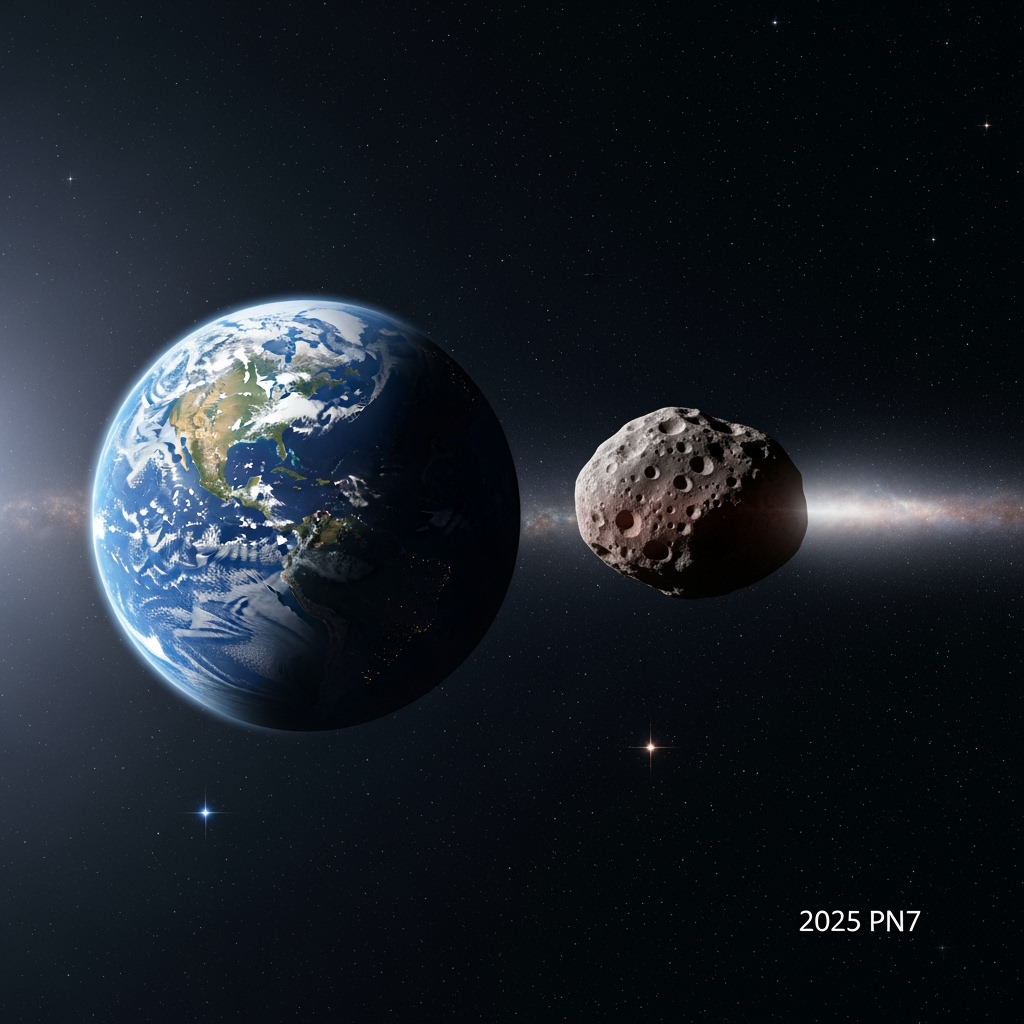
The asteroid, which is no wider than 19 meters, was detected by the Pan-STARRS observatory in Hawaii, according to Live Science. Although ‘2025 PN7’ appears to orbit around Earth, it actually follows a solar orbit nearly synchronized with our planet’s orbit. Scientists predict that this asteroid will continue to accompany Earth for another 60 years before changing its path.
‘2025 PN7’ is the smallest and least stable among six other known ‘quasi-moons’ that accompany Earth in similar orbits. This body falls within a category known as ‘Arjunas,’ which are asteroids that move in harmony with Earth’s orbit around the Sun. The asteroid’s range is between 4.5 million and 59 million kilometers from Earth, making its detection a challenge that requires powerful telescopes, as it cannot be seen with the naked eye.
These objects form what resembles a ‘secondary asteroid belt’ that accompanies Earth and the Moon in their journey around the Sun. The famous ‘quasi-moon’ ‘Kamoʻoalewa’ is more stable, having accompanied Earth for about 381 years. This discovery highlights the astonishing complexities of the solar system and showcases the ability of modern technology to uncover secrets that have been hidden for decades.
The presence of ‘2025 PN7’ raises questions about how many other objects might be accompanying Earth without our knowledge.