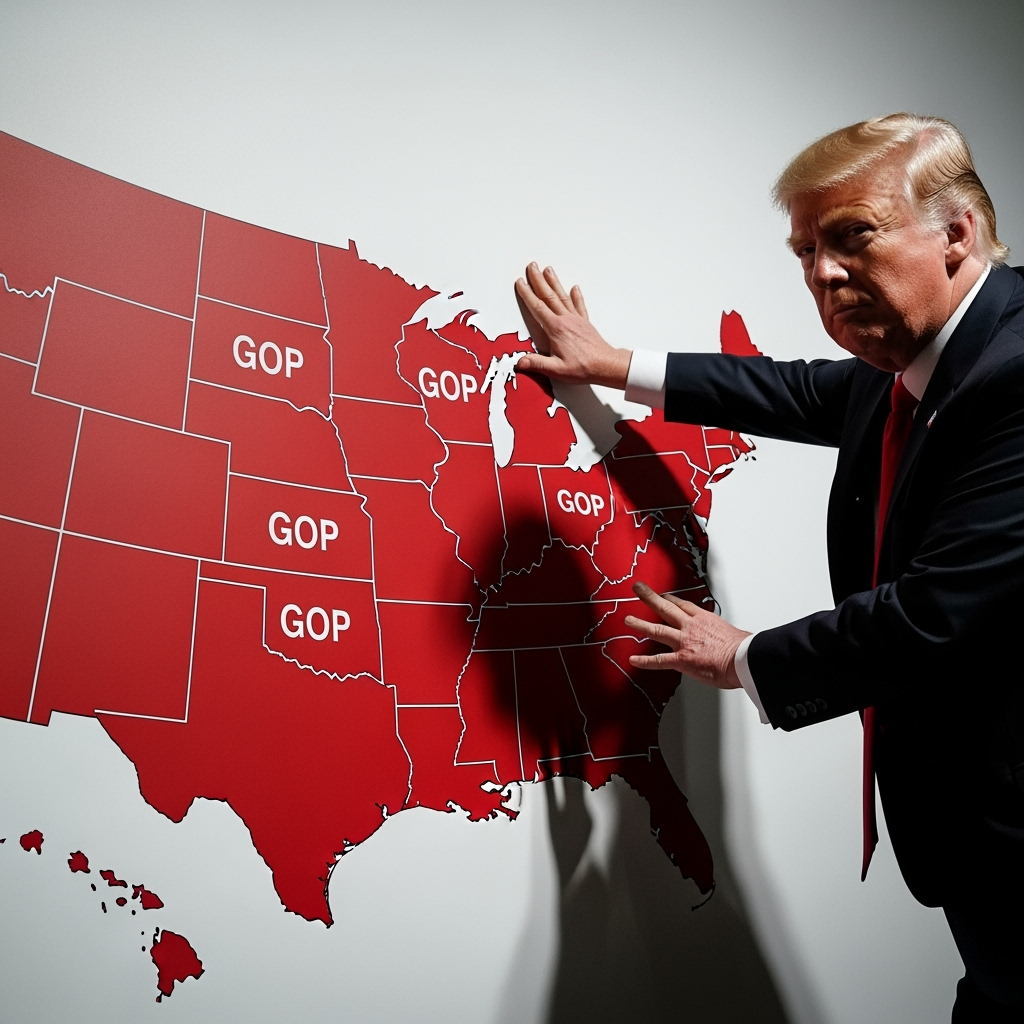
President Donald Trump’s initiative urging Republican-dominated states to redraw their U.S. House districts aims to secure their majority in the upcoming midterm elections. Experts suggest this move might enable Republicans to control the chamber for decades.
Currently, Republicans have a 219-212 House majority. Trump seeks to avoid midterm losses, like those seen in 2018 and 2022, by promoting aggressive redistricting in states such as Texas.
Democratic states, led by California, have threatened to counteract by redrawing districts for partisan advantage—an age-old tactic known as gerrymandering, now enhanced by modern data tools.
Republicans have an edge, governing 23 states compared to the Democrats’ 15. Population changes might add 11 new congressional seats in Republican-dominated Southern and Western states post-2030 Census.
From 1955 to 1995, Democrats held the House unchallenged until Southern Democrats switched to the Republican Party.
The current redistricting conflict raises concerns about intensified gerrymandering, with both parties vying for dominance, further polarizing the nation.
Adam Kinzinger, a Trump critic and ex-Republican congressman, criticized the practice, saying it’s detrimental to political norms and leads to continuous redistricting.
Recently, Texas approved a map securing five more Republican seats. In response, California proposed a map to gain five Democratic seats, pending voter approval in a special election.
A Reuters/Ipsos poll shows most Americans oppose partisan gerrymandering, fearing it endangers democracy.
FEW COMPETITIVE SEATS
Nonpartisan analysts find only about 36 of 435 House districts competitive for the 2026 midterms, shifting contests to party primaries favoring less compromising lawmakers.
Thomas Kahn from American University noted that such strategies could monopolize the House, which he argues is harmful to democracy.
Democratic strongholds, like New York and California, are losing population to Republican states like Florida and Texas, viewed by some Republicans as support for their policies.
Will Kiley from the National Republican Congressional Committee noted that many Californians moving to states like Texas are conservative, seeking better living conditions and governance.
The Reuters/Ipsos poll noted that 21% of Republicans and 14% of Democrats consider relocating to states with lower taxes.
Census data reveals that most population growth in Texas and Florida since 2020 is in minority communities.
Texas, predicted to gain three to four seats post-2030, sees 97% of new residents as Hispanic, Black, or Asian. Florida’s growth is also largely in these groups, potentially gaining two to four seats.
Kareem Crayton from NYU’s Brennan Center highlighted that growth is predominantly in minority communities, which face challenges from these changes.
Recently, minority voters have leaned Republican, with Trump capturing 51% of the Hispanic vote last November, improving from 2020.
The new Texas map caters to Hispanic voters, but Democrats argue it dilutes their power by adding white conservative areas to Hispanic-majority districts.
Congressional tension has escalated since Trump began his second term, leading to moderate Republicans like Don Bacon stepping down due to disagreements with Trump’s policies.
Former Representative John Duarte noted significant issues are being ignored, as political focus shifts away from problem-solving.